
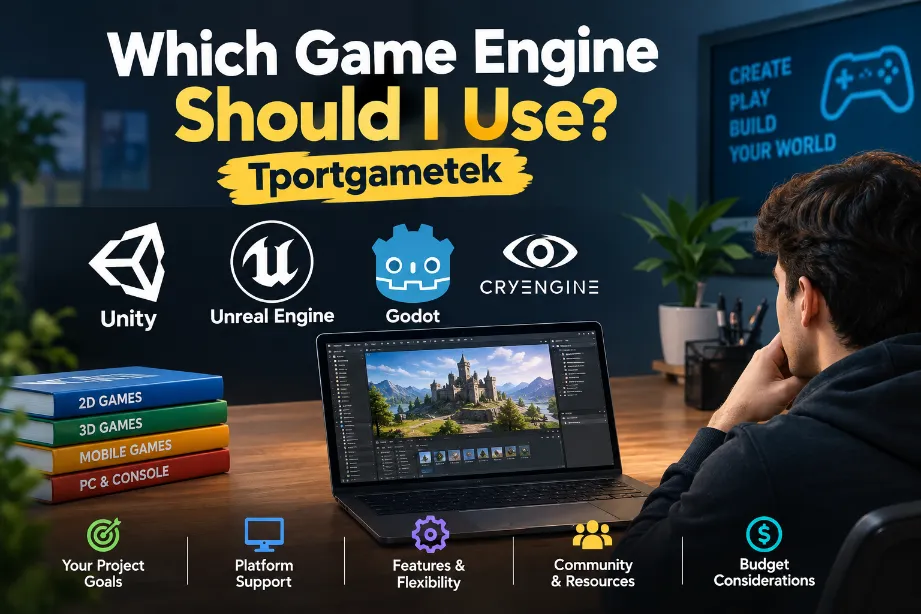
Choosing the right game engine can shape the entire development process, from the first prototype to the final release. For Tportgametek, the best option depends on the type of game, target devices, graphics requirements, team skills, budget, and preferred development workflow.
The main engines worth considering are Unity, Unreal Engine, Godot, and GameMaker. Each one suits a different type of project.
Unity for Flexible Game Development
Unity remains a strong option for developers who want flexibility across multiple platforms. It supports 2D and 3D games, mobile releases, desktop projects, virtual reality, augmented reality, and many other formats.
Unity uses C#, giving developers access to a large ecosystem of learning resources, plugins, assets, and development tools.
For Tportgametek, Unity can make sense for projects that need:
- Android and iOS support
- 2D or 3D gameplay
- Cross-platform releases
- Multiplayer features
- VR or AR support
- A large asset ecosystem
- C# programming
Unity also works well for small development teams because developers can start with a relatively simple prototype and add more systems as the project develops.
Unreal Engine for High-End 3D Games
Unreal Engine makes a strong choice for visually demanding 3D projects. Its rendering technology supports detailed environments, advanced lighting, realistic materials, physics, animation, and cinematic presentation.
Developers can use C++ for deeper programming control while Blueprints provide a visual scripting workflow.
For Tportgametek, Unreal Engine may fit a project that needs:
- Detailed 3D environments
- Realistic visual effects
- Advanced lighting
- Large game worlds
- Cinematic scenes
- Console and PC releases
- High-end visual presentation
Unreal can require more powerful hardware and a more technically demanding workflow, particularly for large-scale projects.
Godot for Lightweight and Open Development
Godot has gained popularity among independent developers because of its lightweight editor, open-source approach, and straightforward workflow.
Its main scripting option, GDScript, has a Python-like style that many new developers find approachable. Godot also supports C# and other development approaches.
Tportgametek could consider Godot for:
- Indie games
- 2D titles
- Small 3D projects
- Experimental games
- Educational projects
- Developers who prefer open-source software
- Teams looking for a lightweight engine
Godot can provide a clean starting point without the size and complexity that may accompany larger commercial engines.
GameMaker for 2D Games
GameMaker focuses heavily on 2D development. Its workflow can help developers create platformers, top-down games, arcade titles, puzzle games, RPGs, and other 2D experiences.
GameMaker uses its own scripting language, GML, alongside visual development features.
For Tportgametek, GameMaker can be a good match for:
- Pixel-art games
- Platformers
- Puzzle games
- Arcade games
- Top-down RPGs
- Small indie projects
- Rapid 2D prototypes
A 2D-focused project may not need the extra technical layers offered by a large 3D engine.
Game Engine Comparison for Tportgametek
| Game Engine | Best For | Main Language | 2D | 3D | Learning Curve |
|---|---|---|---|---|---|
| Unity | Mobile, indie, cross-platform | C# | Excellent | Excellent | Moderate |
| Unreal Engine | High-end 3D and AAA-style games | C++ / Blueprints | Good | Excellent | Moderate to High |
| Godot | Indie and lightweight projects | GDScript / C# | Excellent | Good | Low to Moderate |
| GameMaker | 2D games | GML | Excellent | Limited | Low |
Unity vs Unreal Engine for Tportgametek
Unity and Unreal Engine are the two most practical candidates for many ambitious Tportgametek projects.
Unity offers a broad development environment with strong support for mobile, desktop, VR, AR, 2D, and 3D projects. Unreal Engine puts greater emphasis on advanced 3D visuals and high-end rendering.
| Area | Unity | Unreal Engine |
|---|---|---|
| Mobile games | Excellent | Good |
| 2D games | Excellent | Good |
| 3D games | Excellent | Excellent |
| High-end graphics | Very good | Excellent |
| Visual scripting | Available | Excellent |
| Programming | C# | C++ |
| VR/AR | Strong | Strong |
| Indie development | Strong | Strong |
| Large 3D worlds | Strong | Excellent |
| Ease for beginners | Easier | More demanding |
For a mobile-focused Tportgametek project, Unity may provide a smoother path. For a visually intensive PC or console game, Unreal Engine can offer stronger graphical tools.
Godot vs Unity for Smaller Teams
Godot and Unity can both serve small teams, but their strengths differ.
Godot provides a lightweight environment and open-source codebase. Unity offers a much larger ecosystem with extensive third-party resources and commercial development tools.
Choose Godot for a project that values:
- Simple workflows
- Open-source development
- Lightweight software
- Strong 2D support
- Small project scope
Choose Unity for a project that needs:
- Broad platform support
- Large asset libraries
- Advanced 3D systems
- Extensive third-party tools
- A mature commercial ecosystem
The Best Engine for Mobile Games
Mobile development brings its own technical requirements. Performance, memory use, loading times, touch controls, battery consumption, screen sizes, and device compatibility all matter.
Unity is a particularly strong candidate for Tportgametek mobile projects because it supports both major mobile operating systems and offers tools for performance testing and deployment.
Godot can also work well for smaller mobile games, especially 2D titles.
For a mobile project, consider:
- Target Android and iOS devices
- Expected device performance
- Game resolution
- Texture size
- Memory usage
- Loading speed
- Touch input
- Battery consumption
- Online connectivity
- Monetization systems
The Best Engine for 2D Games
For a purely 2D Tportgametek project, there may be little reason to use an engine designed primarily around advanced 3D production.
GameMaker can work especially well for traditional 2D games, while Godot offers strong 2D tools with an open-source foundation. Unity also provides a capable 2D workflow and gives developers room to move into 3D later.
A simple choice can look like this:
- GameMaker: 2D-first development
- Godot: 2D plus lightweight 3D
- Unity: 2D with a strong path toward 3D
- Unreal Engine: 3D-first development with 2D support
The Best Engine for 3D Games
For Tportgametek projects centered around 3D graphics, Unity and Unreal Engine deserve the most attention.
Unreal Engine has particularly strong tools for realistic environments, lighting, materials, animation, visual effects, and cinematic sequences.
Unity can be preferable for teams that want broad platform support and a familiar C# workflow.
A 3D project should account for:
- Character systems
- Physics
- Lighting
- Animation
- Terrain
- Materials
- Particle effects
- Audio
- Artificial intelligence
- Multiplayer systems
- Performance optimization
The Best Engine for Beginners
New developers should consider the programming language, editor layout, available learning material, and complexity of the project.
Godot provides a relatively approachable starting point. Unity can also serve beginners, particularly those interested in C# and broader game development.
Unreal Engine can still work for new developers, especially through Blueprints, though large 3D projects can introduce more technical concepts.
Engine Selection Based on Project Type
| Tportgametek Project | Recommended Engine |
|---|---|
| Mobile 2D game | Unity / Godot |
| Pixel-art game | GameMaker / Godot |
| Small indie 3D game | Unity / Godot |
| High-end 3D game | Unreal Engine |
| PC action game | Unreal Engine / Unity |
| VR project | Unity / Unreal Engine |
| AR application | Unity |
| Educational game | Godot / Unity |
| Fast 2D prototype | GameMaker / Godot |
| Large cinematic game | Unreal Engine |
Cost and Licensing
Budget can affect the final decision just as much as technical capability. Engine pricing, revenue terms, asset costs, publishing tools, hosting, plugins, and development hardware can all affect the total expense.
Before starting a commercial Tportgametek project, review the current licensing terms directly from the engine provider.
A basic budget should account for:
- Engine fees
- Asset purchases
- Audio resources
- Plugins
- Developer software
- Cloud services
- Multiplayer hosting
- Testing devices
- Store fees
- Marketing
- Maintenance
Pricing policies can change, so developers should verify the current terms before committing to a long production cycle.
Performance Considerations
The engine itself does not automatically determine game performance. Project architecture, asset quality, code, lighting, physics, memory management, rendering settings, and optimization work all affect the final result.
Tportgametek developers should test performance early rather than waiting until the final production stage.
Useful performance checks include:
- Frames per second
- CPU usage
- GPU usage
- RAM consumption
- Loading times
- Draw calls
- Texture memory
- Network latency
- Battery usage on mobile devices
Development Team Skills
The team’s existing skills can save considerable production time.
A team experienced with C# may feel more comfortable with Unity. Developers who already work with C++ may prefer Unreal Engine. Teams interested in a lightweight scripting workflow can consider Godot, while 2D-focused creators may prefer GameMaker.
| Team Skill | Suitable Option |
|---|---|
| C# | Unity |
| C++ | Unreal Engine |
| GDScript | Godot |
| GML | GameMaker |
| Visual scripting | Unreal Engine |
| 2D-focused design | GameMaker / Godot |
Which Game Engine Should I Use Tportgametek?
For most Tportgametek projects, Unity is the safest all-round option when the goal involves mobile, PC, 2D, 3D, VR, or cross-platform development.
Unreal Engine makes more sense for a project where premium 3D graphics, realistic environments, cinematic presentation, or advanced rendering sit at the center of the experience.
Godot suits smaller teams, open-source projects, 2D games, and lightweight development.
GameMaker deserves consideration for projects focused almost entirely on 2D gameplay.
The simplest decision is:
- Choose Unity for broad flexibility.
- Choose Unreal Engine for advanced 3D visuals.
- Choose Godot for lightweight and open-source development.
- Choose GameMaker for focused 2D development.
Final Recommendation for Tportgametek
There is no single engine that fits every Tportgametek project. The right choice depends on the game genre, target platform, graphics target, team experience, budget, and production scale.
For a versatile development path, Unity offers the broadest balance. For demanding 3D production, Unreal Engine deserves priority. For lightweight indie development, Godot can be an excellent fit. For dedicated 2D production, GameMaker can reduce unnecessary technical overhead.
Starting with a small prototype can also provide useful evidence before a full production commitment. Test the core gameplay, performance, controls, workflow, and export process first. That practical test can reveal more than engine specifications alone.