
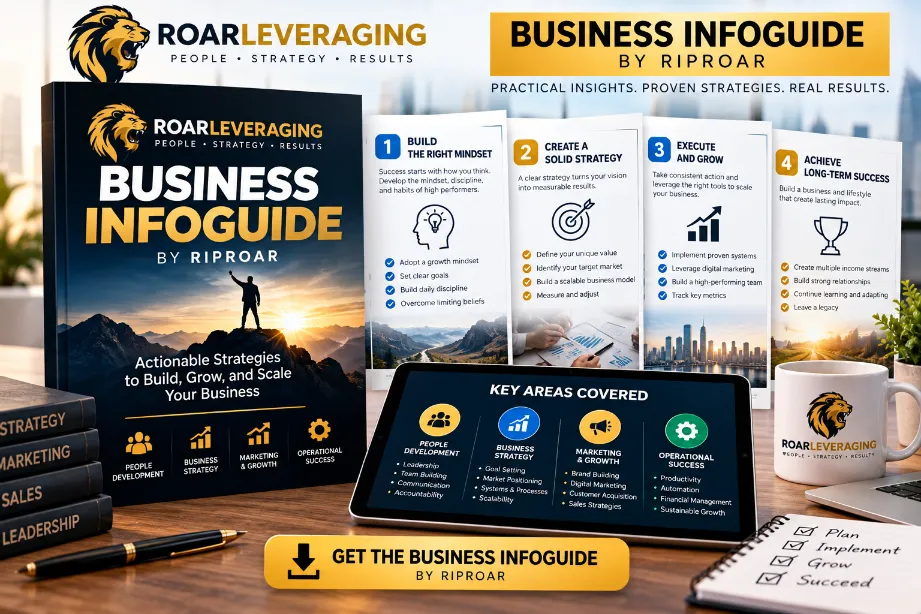
Roarleveraging Business Infoguide by Riproar presents a practical approach to business growth based on better use of resources already available to a company. The framework focuses on areas such as customer data, staff skills, technology, brand assets, marketing channels, products, and internal processes.
Riproar presents RoarLeveraging as a way to turn existing business resources into measurable opportunities. The approach can suit startups, small businesses, marketing teams, operations managers, consultants, and founders looking for a structured growth process.
The main idea centers on getting more value from current resources before adding major expenses.
What RoarLeveraging Business Infoguide Means
RoarLeveraging combines business information with the idea of leverage. The framework encourages companies to review their current resources and identify areas that may produce better results through smarter use.
These resources may cover:
- Customer information
- Existing products
- Brand assets
- Employee skills
- Sales channels
- Website traffic
- Marketing data
- Technology
- Internal processes
- Customer relationships
The approach focuses on turning available business information into practical actions.
Main Purpose of the Riproar InfoGuide
The Riproar InfoGuide focuses on practical business growth. It encourages companies to review their resources, locate opportunities, test ideas, measure results, and expand approaches that produce useful outcomes.
| Business Area | Main Focus |
|---|---|
| Business assets | Find unused resources |
| Customer data | Review customer behavior |
| Marketing | Improve current campaigns |
| Operations | Reduce unnecessary work |
| Technology | Automate repetitive tasks |
| Brand | Improve business messaging |
| Growth planning | Set measurable targets |
A short planning cycle can help businesses turn broad goals into manageable tasks.
Core Areas Covered by RoarLeveraging
RoarLeveraging places attention on several areas of business activity.
- Asset mapping: Review available company resources.
- Data analysis: Study customer, sales, website, and marketing information.
- Brand messaging: Test clearer messages for target audiences.
- Process improvement: Find repetitive tasks that require excessive time.
- Customer analysis: Review purchases, feedback, and engagement.
- Growth experiments: Test smaller ideas before larger spending.
- Performance tracking: Monitor selected business measurements.
These areas can work together as part of a practical business-growth process.
How the Business InfoGuide Uses Existing Resources
RoarLeveraging places current resources at the center of planning. A company may already have customer records, website visitors, email subscribers, product information, social audiences, skilled staff, and established sales channels.
Instead of immediately adding another expense, the business can review the performance of its current resources.
For example, an online store may receive substantial website traffic but produce few purchases. The company could review product pages, checkout steps, email follow-ups, customer segments, and website navigation before increasing its advertising budget.
Customer Data in RoarLeveraging
Customer data forms an important part of the framework. Businesses can review information from CRM systems, website analytics, email campaigns, customer support, surveys, and purchase records.
Useful measurements can cover:
- Repeat purchase rate
- Customer lifetime value
- Conversion rate
- Customer acquisition cost
- Customer churn
- Email engagement
- Product usage
- Support requests
- Average order value
A company can connect these measurements with specific business actions and track the resulting changes.
RoarLeveraging and Marketing
Marketing represents another practical use for RoarLeveraging. Businesses can review existing customer information, brand material, content, advertising channels, and campaign results.
A company can review:
- Which channels generate qualified leads.
- Which campaigns produce sales.
- Which customer groups purchase repeatedly.
- Which messages receive stronger responses.
- Which marketing tasks consume excessive staff time.
- Which existing content can support additional campaigns.
This process can help marketing teams direct resources toward measurable business goals.
RoarLeveraging for Small Businesses
Small businesses can use a resource-focused approach because budget limitations can make every investment important.
A small company may already have:
- Loyal customers
- An email list
- Positive product reviews
- Website visitors
- Skilled employees
- Social media followers
- Valuable sales records
RoarLeveraging encourages business owners to review these resources before making major new investments.
RoarLeveraging for Startups
Startups can also apply the framework to their existing resources. A young company may have limited staff, funding, customer data, and marketing reach, making resource allocation an important part of growth planning.
A startup can use the approach by:
- Reviewing current product usage
- Identifying strong customer segments
- Studying recurring customer complaints
- Testing one growth idea at a time
- Tracking customer acquisition
- Monitoring retention
- Reducing repetitive manual work
- Giving clear responsibilities to team members
A structured process can help startups connect spending with measurable business activity.
A Simple RoarLeveraging Workflow
A practical RoarLeveraging workflow can follow several stages.
Step 1: List current resources
- Write down staff skills, customer information, technology, products, sales channels, content, and brand assets.
Step 2: Review performance
- Collect measurements from sales, marketing, website activity, customer service, and operations.
Step 3: Find weak areas
- Look for areas where a small improvement could produce a useful business result.
Step 4: Select one test
- Choose a manageable initiative instead of changing many areas at once.
Step 5: Set a measurement
- Pick a measurement that can show progress, such as leads, conversion rate, revenue, repeat purchases, or cost reduction.
Step 6: Review the outcome
- Compare the new result with the original baseline.
Step 7: Scale or revise
- A useful result can receive additional resources. A weak result can lead to a revised test.
RoarLeveraging Metrics to Track
A business needs measurable indicators to review its experiments and growth activities.
| Business Area | Useful Measurement |
|---|---|
| Sales | Revenue and average order value |
| Marketing | Conversion rate and advertising return |
| Customers | Retention and repeat purchases |
| Website | Visitors, leads, and conversions |
| Operations | Processing time and operating cost |
| Support | Resolution time and customer satisfaction |
| Finance | Profit margin and acquisition cost |
The measurements should match the business objective rather than fill a dashboard with numbers that provide little practical value.
Benefits of the RoarLeveraging Approach
The framework offers several areas that can support business planning:
- Better use of existing resources
- More focused growth tests
- Greater use of customer data
- Clearer short-term targets
- Better performance tracking
- Less reliance on guesswork
- More structured marketing decisions
- Greater attention to process efficiency
These elements can help a business organize its growth activities around measurable outcomes.
Limitations to Keep in Mind
The term RoarLeveraging appears across different websites, and descriptions may vary from one source to another. Riproar presents its own framework, while third-party pages may describe the term in broader ways.
Readers researching RoarLeveraging should therefore check the specific source behind each claim.
There also does not appear to be one universally established business methodology under the RoarLeveraging name. The available Riproar material presents it as a practical framework for resource use, planning, testing, and business growth.
Who Can Use RoarLeveraging Business InfoGuide?
The framework can suit several business groups:
- Startup founders
- Small business owners
- Marketing managers
- Operations teams
- Growth teams
- Consultants
- Ecommerce operators
- Mid-size business leaders
It can be particularly useful for companies that already have customer information, products, staff skills, technology, or digital channels available for further use.
RoarLeveraging 30–90 Day Business Plan
A short planning period can turn the framework into practical business tasks.
| Period | Main Work |
|---|---|
| Days 1–15 | Audit resources and collect baseline measurements |
| Days 16–30 | Map opportunities and select a test |
| Days 31–60 | Run the initiative and monitor results |
| Days 61–90 | Review results and plan the next action |
This structure gives teams a clear time period for testing an idea and reviewing its performance.
Practical Example of RoarLeveraging
Suppose an ecommerce company has a large customer database but a low repeat-purchase rate.
The company can review purchase history, email engagement, customer feedback, and product categories. It can then identify customers who made one purchase but have not purchased again.
The business could run a targeted follow-up campaign with relevant products or offers. Afterward, the team could review repeat purchases, revenue per customer, and campaign conversion.
This example shows how an existing customer database and communication channel can support a new growth test without requiring a completely new business system.
Roarleveraging Business Infoguide by Riproar: Final Take
Roarleveraging Business Infoguide by Riproar presents a resource-focused approach to business growth. Its central idea centers on making better use of available people, data, technology, customers, brand assets, and business systems.
The framework gives attention to resource audits, opportunity mapping, measurable experiments, marketing performance, customer data, and short-term planning.
For anyone researching Roarleveraging Business Infoguide by Riproar, the most useful starting point is the framework’s practical focus: review existing resources, select measurable opportunities, test focused ideas, track results, and adjust future business actions based on the data.