
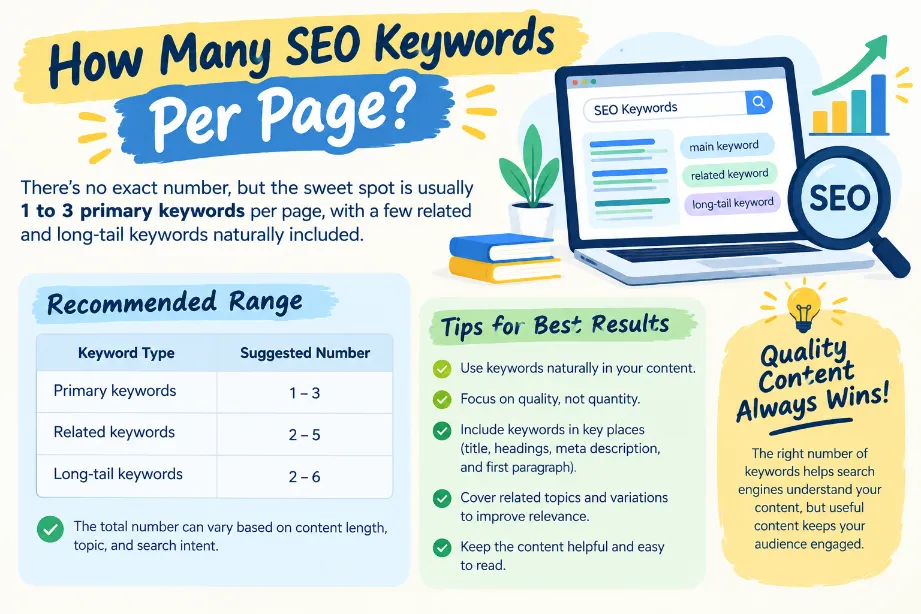
There is no fixed number of SEO keywords that every page should target. A practical approach is to assign one primary keyword or search phrase to a page, then add a small group of closely related terms that support the same search intent.
For most standard pages, this works well:
| Page type | Primary keyword | Related keywords |
|---|---|---|
| Blog post | 1 | 3–8 |
| Product page | 1 | 2–6 |
| Service page | 1 | 3–8 |
| Category page | 1 | 3–10 |
| Landing page | 1 | 2–6 |
| Detailed guide | 1–2 | 5–15 |
These numbers serve as working ranges rather than SEO rules. Google does not publish a required keyword count for individual pages. Search performance depends on how well a page satisfies the query, the quality of the information, site structure, links, technical SEO, and many other signals.
Google also warns against keyword stuffing, which means adding keywords repeatedly or unnaturally for ranking purposes.
One Primary Keyword Per Page
A page usually works best with one clear primary search target.
For example, a page targeting “how many SEO keywords per page” can naturally cover related phrases such as:
- SEO keywords per page
- number of keywords per page
- how many keywords should a page target
- SEO keyword density
- primary keyword
- secondary keywords
- related search terms
- keyword targeting
The primary phrase gives the page a clear subject. Related terms help cover different ways searchers may describe the same need.
This approach also reduces the chance of creating several pages that compete for nearly identical searches.
How Many Keywords Should a Blog Post Target?
A normal blog post can target one main keyword plus several closely connected terms.
A 1,000-word post may need only a handful of relevant phrases. A 3,000-word guide may naturally cover a larger group because it answers more questions.
The word count itself does not decide the keyword count.
A better method is to ask:
- What does the searcher want from this page?
- What questions naturally follow the main query?
- Which related phrases help answer those questions?
- Can each term appear naturally?
- Does the page provide useful information for the search terms?
A page should never become a list of phrases simply because a keyword tool produced hundreds of suggestions.
How Many Keywords Should a Service Page Target?
A service page can focus on one core service phrase and several close variations.
For example, a digital marketing agency could create a page around:
Primary keyword: SEO services
Related terms might cover:
- SEO agency
- professional SEO services
- SEO services for small businesses
- technical SEO services
- local SEO services
- SEO consulting
The page can address these related searches through sections, examples, service details, FAQs, and supporting information.
A separate page may make more sense for a service with a different search intent. For example, “local SEO services” and “ecommerce SEO services” may deserve separate pages because their audiences and needs differ.
How Many Keywords Should a Product Page Target?
Product pages usually need a tighter keyword focus.
A product page can target:
- Product name
- Product category
- Main product type
- Important product attribute
- Relevant commercial phrase
For example, a page selling a waterproof hiking backpack could focus on waterproof hiking backpack and naturally use related terms such as:
- waterproof backpack for hiking
- hiking backpack
- outdoor backpack
- waterproof daypack
- hiking pack
The product description should prioritize useful details such as size, materials, capacity, features, compatibility, shipping information, and usage.
Repeating the exact product keyword in every paragraph adds little value and can make the copy feel forced.
How Many Keywords Should a Landing Page Target?
A landing page usually benefits from a narrow keyword focus.
One primary phrase works well for pages designed around a single offer, product, service, or conversion goal.
For example:
Primary keyword: accounting software for small business
Supporting phrases can address related needs such as:
- small business accounting software
- online accounting software
- accounting software for startups
- business bookkeeping software
Keep the language natural. A visitor should feel that the page was written for their problem rather than for a keyword counter.
Should You Use Secondary Keywords?
Yes. Secondary keywords can help a page cover related searches and subtopics.
They should have a clear connection to the main subject. A useful secondary keyword usually does one of three things:
- Describes a close variation of the main query
- Answers a related question
- Adds useful subject-specific detail
For example, a page about technical SEO could naturally discuss:
- crawlability
- indexing
- XML sitemaps
- canonical URLs
- site speed
- structured data
- internal links
Google can use page content to determine what a page covers. A page does not need to repeat every search phrase word for word.
What Is the Ideal Keyword Density?
There is no universal keyword density percentage that guarantees rankings.
Older SEO practices sometimes promoted formulas such as 1%, 2%, or 3%. Modern SEO should not rely on a fixed percentage.
For example, a 1,500-word page does not need exactly 15 uses of a keyword simply because someone recommends a 1% density.
Use the phrase at natural points such as:
- Page title
- Main heading
- Opening section
- Relevant subheadings
- Body copy
- Image alt text, where descriptive and appropriate
- URL, where practical
- Meta description, where useful
Then write naturally around the topic.
Google specifically describes excessive repetition of words or phrases that makes content sound unnatural as keyword stuffing.
How Many Times Should the Primary Keyword Appear?
There is no fixed number.
The primary keyword should appear enough for the page topic to remain clear, but not so frequently that the writing sounds repetitive.
For a 1,500-word page, the phrase might appear several times. Another page may need fewer uses because natural wording already makes the subject clear.
Good SEO copy can use variations instead of repeating one exact phrase:
Primary phrase: SEO keywords per page
Natural variations:
- keywords for one webpage
- page keyword strategy
- target keywords
- primary search term
- related search phrases
- keyword targeting
Search engines can connect related language and concepts without requiring exact-match repetition throughout the page.
Should Every Page Have a Different Primary Keyword?
Pages should have a distinct purpose, but that does not mean every page needs a completely unrelated keyword.
Two pages can target related searches if they satisfy different search needs.
For example:
- “Local SEO services”
- “Local SEO pricing”
- “How local SEO works”
- “Local SEO audit”
Each phrase represents a different user need.
Problems arise with pages that have nearly identical content and target the same search purpose. Google may treat highly similar pages as duplicates and select a canonical page for search results.
How to Find the Right Number of Keywords
Start with the primary query, then build a small group of relevant terms around it.
A simple process works well:
- Select the main search query.
- Review related searches and questions.
- Group phrases with the same search intent.
- Remove phrases that belong to another topic.
- Assign closely related terms to the same page.
- Create separate pages for clearly different search needs.
- Write the page for the reader first.
- Review keyword use after writing.
This method keeps keyword research connected to the actual page purpose.
Keyword Mapping for a Website
Keyword mapping assigns search terms to specific URLs.
A simple keyword map may look like this:
| URL | Primary keyword | Supporting terms |
|---|---|---|
| /seo-services/ | SEO services | SEO agency, SEO company, professional SEO |
| /local-seo/ | local SEO | local search optimization, local SEO services |
| /technical-seo/ | technical SEO | crawlability, indexing, technical optimization |
| /keyword-research/ | keyword research | keyword analysis, search terms, keyword tools |
This structure gives each page a clear search focus.
It can also reduce internal competition between pages that target the same phrase.
How Search Intent Affects Keyword Count
Search intent should guide keyword selection more than a keyword quota.
Four common search intents are:
- Informational: The searcher wants an explanation or answer.
- Commercial: The searcher is researching products or services.
- Transactional: The searcher wants to purchase, sign up, or take an action.
- Navigational: The searcher wants a particular website, brand, or page.
A page should target terms that match its purpose.
For example, a product page targeting buy running shoes online should provide product and purchase information. A guide targeting how to choose running shoes should focus on advice and selection criteria.
Putting both topics onto one page simply to target more phrases can weaken the page’s focus.
Keyword Clusters Work Better Than Keyword Lists
A keyword cluster groups closely related searches around one subject.
For a page targeting content marketing strategy, a cluster could contain:
- content marketing strategy
- content strategy
- content marketing plan
- content planning
- content calendar
- content marketing process
- content strategy framework
These terms can support different sections of one comprehensive page, provided they share the same search intent.
A separate page makes more sense for a phrase that requires a substantially different answer.
Avoid Keyword Stuffing
Keyword stuffing can make copy awkward and may fall under Google’s spam policies.
Warning signs include:
- Repeating the same phrase in every paragraph
- Adding long keyword lists without useful information
- Placing unrelated search terms on a page
- Writing sentences around keywords instead of reader needs
- Adding city or location lists solely for search visibility
- Using keywords in places where they do not make grammatical sense
Google defines keyword stuffing as filling a page with keywords or numbers to manipulate Search rankings.
A better approach uses relevant terms naturally while giving the reader complete information.
Where to Place SEO Keywords
A primary keyword can appear in several useful areas of a page.
| Page element | Keyword use |
|---|---|
| Title tag | Primary phrase where natural |
| H1 | Main topic or close variation |
| First section | Natural mention |
| H2/H3 headings | Relevant variations |
| Body content | Natural usage |
| URL | Short, descriptive version |
| Image alt text | Only where it describes the image |
| Meta description | Clear phrase where natural |
| Internal links | Descriptive anchor text |
No page element needs forced repetition.
The title and heading should accurately describe the page. Google also provides guidance around search appearance, structured data, title links, snippets, and other ways pages can appear in Search.
How Many Keywords Per 1,000 Words?
A 1,000-word page does not need a fixed keyword quota.
A useful working model looks like this:
| Content length | Suggested keyword approach |
|---|---|
| 500–800 words | 1 primary + 2–5 related terms |
| 800–1,500 words | 1 primary + 3–8 related terms |
| 1,500–2,500 words | 1 primary + 5–12 related terms |
| 2,500+ words | 1 primary + a broader topic cluster |
These ranges are editorial guidelines, not Google requirements.
A short page can cover a topic thoroughly with five terms. A long guide may naturally use dozens of related phrases. The subject, search intent, and depth should guide the final number.
Should You Target Multiple Primary Keywords?
Two closely related primary phrases can work on one page if they serve the same search intent.
For example:
- SEO keyword research
- keyword research for SEO
These phrases may fit naturally on one page.
Two unrelated primary phrases usually need separate pages.
For example:
- SEO keyword research
- email marketing automation
Trying to make one page rank for unrelated subjects can make the content unfocused.
SEO Keywords Per Page: A Practical Rule
For most pages, start with one primary keyword and 3–8 closely related terms.
Increase the number only as the topic requires more coverage.
Use this simple checklist:
- One clear primary search phrase
- A small group of related terms
- One consistent search intent
- Natural keyword placement
- Useful headings
- Original information
- Strong internal linking
- Descriptive title and URL
- No forced repetition
- No unrelated keyword lists
Google’s spam policies also address scaled content, hidden text, link spam, doorway abuse, and other tactics aimed at manipulating Search visibility.
Final Keyword Strategy
The right number of SEO keywords per page depends on the subject rather than a fixed formula.
For a standard page, one primary keyword plus 3–8 related phrases gives a practical starting point. Broader guides may naturally require more terms, while focused landing pages may need fewer.
The goal is simple: give each URL a clear topic, match the searcher’s intent, cover the subject thoroughly, and use search terms naturally.
A page does not need dozens of repeated keywords to show relevance. Strong topical coverage, useful information, clear page structure, and natural language create a better foundation for search visibility.
The SEO guidance above follows current Google Search Central documentation, particularly its guidance on keyword stuffing, spam policies, canonicalization, and search appearance.