
Lyncconf Mods for Lccnfskyrimtool refers to a Skyrim modding topic centered on adding, managing, and adjusting custom game content through a dedicated tool or modding workflow. Players who use Skyrim mods usually want smoother installation, better visual quality, fresh gameplay mechanics, or a more personal game setup.
The main appeal comes from having greater control over the game environment. A carefully arranged mod list can change textures, characters, weapons, locations, lighting, menus, combat systems, and many other parts of Skyrim.
Before adding any file, check its compatibility with the Skyrim version, existing modifications, and the tool being used. A small amount of preparation can prevent crashes, missing textures, broken quests, and other problems.
What Lyncconf Mods for Lccnfskyrimtool Can Do
A Skyrim mod setup can change the game in many ways. The exact results depend on the selected files and the order used during installation.
Common mod categories include:
| Mod Category | Main Purpose | Typical Result |
|---|---|---|
| Texture Mods | Improve surface details | Sharper environments |
| Weather Mods | Change atmospheric effects | New skies and weather |
| Combat Mods | Adjust fighting mechanics | More varied battles |
| Character Mods | Alter models or appearance | New character visuals |
| Quest Mods | Add new missions | Additional gameplay |
| Interface Mods | Adjust menus and HUD | Cleaner controls |
| Audio Mods | Replace sounds | Different game atmosphere |
| Performance Mods | Reduce technical strain | Smoother gameplay |
This range makes Skyrim highly flexible. A player focused on graphics may choose texture and lighting files, while another player may prefer combat, quests, survival mechanics, or character customization.
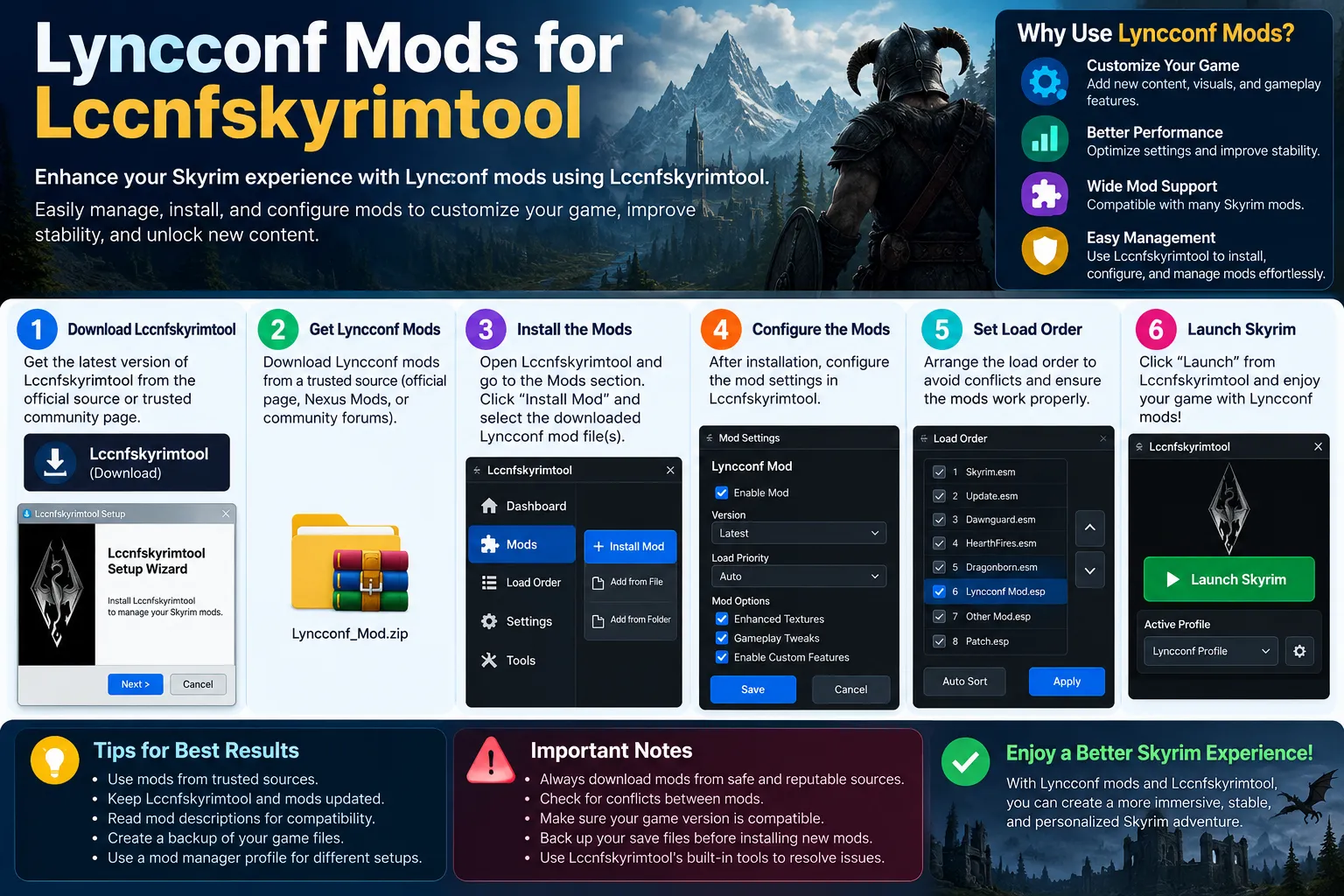
Preparing Skyrim Before Mod Installation
A clean preparation stage gives each modification a safer environment. Start with the game version and then check the requirements listed by the mod creator.
Use this checklist:
- Update Skyrim through the official game platform.
- Create a backup of important save files.
- Check every mod’s requirements.
- Confirm compatibility with your Skyrim edition.
- Read installation instructions carefully.
- Keep track of every downloaded file.
- Avoid adding many unknown files at the same time.
- Test the game after major changes.
A backup gives you a practical recovery point. Save files should remain separate from the main modding workspace so a damaged installation does not affect every copy.
Lyncconf Mods for Lccnfskyrimtool Installation Process
The installation process depends on the tool and the mod package. Some files use automatic installers, while others require manual placement inside specific Skyrim folders.
A basic workflow looks like this:
- Download the selected mod from a trusted source.
- Check the file requirements and supported Skyrim version.
- Read the installation instructions.
- Install the required framework or dependency.
- Add the mod through the selected mod manager.
- Check plugin order and file conflicts.
- Launch Skyrim.
- Test the affected feature.
- Review the setup again after adding additional mods.
Do not install a large collection in one step. Testing each small group makes troubleshooting much easier. A single new file can create a conflict, and gradual installation makes that conflict easier to locate.
Checking Mod Compatibility
Compatibility plays a major role in Skyrim mod management. Two modifications can edit the same game resource, script, character, location, or visual asset.
Before adding a new file, check:
- Skyrim edition
- Game version
- Required frameworks
- Required libraries
- Plugin dependencies
- Load order requirements
- Compatibility patches
- Conflicting files
- Installation instructions
A useful tracking table can save time:
| Mod Name | Category | Dependency | Tested | Conflict |
|---|---|---|---|---|
| Mod A | Graphics | Texture framework | Yes | None |
| Mod B | Combat | Script framework | Yes | Minor |
| Mod C | Interface | UI framework | No | Unknown |
| Mod D | Quest | Base game | Yes | None |
Keeping this information in a spreadsheet or simple text file makes larger mod collections easier to manage.
Managing Load Order
Load order determines how Skyrim processes many plugins. A poorly arranged list can cause missing content, visual glitches, crashes, or changes that fail to appear inside the game.
Use your selected mod manager’s sorting tools where suitable, then check the instructions supplied with individual files.
A practical load-order routine:
- Sort the plugin list.
- Review files with special placement instructions.
- Check patches after their parent mods.
- Look for missing dependencies.
- Test the game after major changes.
- Keep a record of changes.
Players should avoid moving plugins around randomly. Make one adjustment at a time and test the result before changing another part of the list.
Common Lccnfskyrimtool Mod Problems
Modding problems can appear in several forms. The symptom often provides a clue about the source.
| Problem | Possible Cause | Suggested Action |
|---|---|---|
| Game crashes at startup | Missing dependency | Check requirements |
| Purple textures | Missing texture file | Reinstall the affected mod |
| NPC appearance error | Asset conflict | Review conflicting files |
| Quest does not start | Plugin conflict | Check load order |
| Menu looks broken | UI conflict | Disable recent UI changes |
| Performance drops | Heavy visual files | Reduce demanding graphics mods |
| Game freezes | Script conflict | Test recently added scripts |
Do not remove every modification after one error. First identify the last change, test it separately, and review the related requirements.
Graphics Mods and Visual Settings
Graphics-focused Skyrim modifications can improve textures, lighting, landscapes, water, weather, and character models. High-resolution assets may also increase memory and graphics-card usage.
For a balanced setup, consider combining visual files gradually. Start with one category, test performance, then add another.
Useful areas to adjust include:
- Texture resolution
- Shadow quality
- Lighting effects
- Grass density
- Water quality
- Weather effects
- View distance
- Ambient effects
A visually demanding setup may require lower in-game settings. Players using older hardware can prioritize texture improvements while limiting heavy lighting and shadow effects.
Performance Tips for Skyrim Mods
Performance depends on hardware, game settings, mod selection, resolution, and the number of active scripts.
Try these practical steps:
- Keep graphics settings suitable for your hardware.
- Avoid stacking several heavy weather systems.
- Test high-resolution textures individually.
- Monitor frame rate after major changes.
- Remove redundant visual modifications.
- Keep required frameworks updated.
- Use performance-focused tools recommended for your Skyrim edition.
A stable setup does not require hundreds of modifications. A smaller collection with good compatibility can provide a smooth experience.
Lyncconf Mods for Lccnfskyrimtool Troubleshooting Guide
Start troubleshooting from the most recent change. This method reduces unnecessary work and makes the source of an error easier to identify.
Follow this sequence:
Step 1: Close Skyrim and the mod manager.
Step 2: Identify the most recently added or updated file.
Step 3: Check its requirements.
Step 4: Review its load-order position.
Step 5: Disable the recent modification temporarily.
Step 6: Launch Skyrim and test the affected area.
Step 7: Add the modification again after correcting the conflict.
This process works particularly well for crashes, missing textures, broken menus, and script-related errors.
Safe Sources for Skyrim Mod Files
Use established modding communities and official documentation for downloads and technical information. Source quality matters because random file-hosting pages can contain outdated packages, incorrect instructions, or unsafe downloads.
Useful resources include:
- Nexus Mods for Skyrim mod collections and descriptions.
- Bethesda support resources for game-related help.
- Official Skyrim platform pages for game information.
- Mod documentation supplied by individual creators.
Always check the page date, supported game version, requirements, and installation notes before downloading.
Building a Practical Skyrim Mod List
A useful mod list starts with a clear goal. Decide whether the setup focuses on graphics, role-playing, combat, quests, survival, immersion, or a mixture.
A simple structure can look like this:
| Priority | Mod Type | Purpose |
|---|---|---|
| 1 | Framework | Provides required functions |
| 2 | Fixes | Addresses technical issues |
| 3 | Interface | Improves menus |
| 4 | Visuals | Changes graphics |
| 5 | Gameplay | Changes mechanics |
| 6 | Quests | Adds new content |
| 7 | Audio | Changes sound |
| 8 | Optional Extras | Adds personal touches |
This structure helps keep the setup organized and makes later troubleshooting easier.
Final Tips for Lyncconf Mods for Lccnfskyrimtool
Lyncconf Mods for Lccnfskyrimtool can serve as a useful reference point for Skyrim players who want a more customized game setup. The best results come from careful file selection, compatibility checks, gradual installation, and regular testing.
Keep these points in mind:
- Back up saves before major changes.
- Read every mod’s requirements.
- Add modifications gradually.
- Keep a record of the load order.
- Test after major adjustments.
- Remove conflicting files rather than stacking replacements.
- Match visual settings to your hardware.
- Use reliable download sources.
- Keep your mod manager organized.
- Preserve a clean backup for recovery.
A thoughtful mod setup can make Skyrim feel fresh without creating unnecessary technical problems. Start with a small collection, test each addition, and expand the setup around the type of gameplay you want.