
Betterthisfacts tips from Betterthisworld focus on practical ways to improve daily habits, manage time, learn useful information, and make smarter decisions. These ideas work best as small actions that fit naturally into a regular routine rather than strict plans that feel difficult to maintain.
The main areas covered by this topic are personal growth, productivity, healthy routines, digital awareness, and everyday problem-solving. Readers can apply these suggestions at home, at school, or at work without expensive tools or complicated schedules.
What Are Betterthisfacts Tips From Betterthisworld?
BetterThisFacts is an information-focused topic connected with BetterThisWorld. Related online content discusses useful knowledge, practical advice, daily habits, and ways to apply information to everyday situations.
The general idea is simple: learn something useful, check its reliability, and apply it to a real situation.
Readers can use this approach to work on areas such as:
- Productivity: Organize tasks and reduce distractions.
- Personal development: Create manageable routines and track progress.
- Health and wellness: Make sensible choices about rest, movement, and daily activities.
- Digital awareness: Check online claims before sharing them.
- Practical learning: Turn useful information into actions that solve everyday problems.
The value comes from putting advice into practice instead of collecting tips without using them.
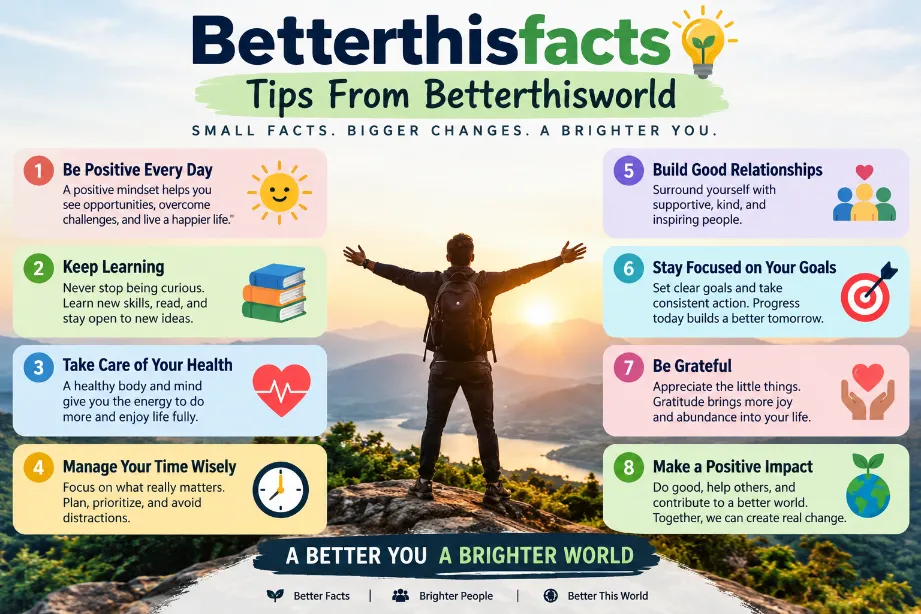
Betterthisfacts Tips From Betterthisworld at a Glance
| Topic | Practical Tip | Expected Benefit |
|---|---|---|
| Time management | Write down three priority tasks | A clearer daily plan |
| Productivity | Work on one task at a time | Fewer distractions |
| Healthy routines | Keep a regular sleep schedule | More consistent rest |
| Personal growth | Read for 10 minutes daily | A steady learning habit |
| Money management | Record daily spending | Better budget awareness |
| Digital safety | Verify claims with reliable sources | Fewer mistakes |
| Organization | Prepare tomorrow’s task list tonight | An easier morning |
These suggestions offer a starting point. Results depend on individual circumstances, consistency, and the way each habit fits into daily life.
1. Plan Your Day Around Three Priorities
A long to-do list can make even a manageable day feel stressful. Start by writing down three tasks that deserve your attention. Complete the most urgent or valuable task first, then move to the next one.
For example, a student might prioritize finishing an assignment, reviewing a difficult lesson, and preparing for an upcoming test. Someone at work might focus on a deadline, an important email, and a scheduled meeting.
Try this simple routine:
- Write three priorities each morning.
- Assign a realistic time to each task.
- Break larger jobs into smaller steps.
- Review unfinished tasks at the end of the day.
This method gives your day direction without filling every minute with work.
2. Focus on One Task at a Time
Multitasking may feel productive, but switching between unrelated tasks can interrupt concentration and create extra work. A more practical approach is to give one activity your full attention for a set period.
Try a 25-minute work session followed by a five-minute break. Use this pattern for studying, writing, household chores, or office assignments.
Helpful actions:
- Silence unnecessary notifications.
- Keep only the materials needed for your current task nearby.
- Set a timer to mark the work period.
- Take a short break before starting another session.
This approach gives you a simple structure for focused work. Adjust the session length to suit your task and energy level.
3. Create Small Habits That Fit Your Routine
Personal growth does not require a complete lifestyle change overnight. Small actions can make progress easier to maintain, especially if you attach them to activities you already perform.
For example, read two pages after breakfast, stretch after sitting for a long period, or prepare your bag before going to bed.
Use these steps to start a new habit:
- Choose one specific action.
- Connect it to an existing daily activity.
- Start with a version that takes two minutes.
- Track each successful attempt on a calendar.
- Increase the effort gradually as the routine becomes easier.
Missing a day does not erase earlier progress. Resume the routine at the next suitable opportunity and avoid turning a small setback into a reason to quit.
4. Protect Your Sleep and Daily Energy
Sleep supports attention, learning, mood, and general health. The CDC recommends at least seven hours of sleep per night for most adults aged 18–60. Teenagers and younger children generally need more. Individual requirements can vary by age and personal circumstances.
Betterthisfacts tips from Betterthisworld can be applied to daily wellness through simple routines such as:
- Maintain a reasonably consistent bedtime.
- Reduce bright screens and stimulating activities before bed.
- Keep your sleeping area comfortable, dark, and quiet.
- Get regular physical activity suited to your abilities.
- Limit caffeine late in the day.
Avoid expecting one bedtime change to solve every problem. Consistent sleep habits offer a more practical starting point than drastic changes.
5. Manage Your Money With a Simple Budget
A basic budget helps you see how much money enters your account, where it goes, and how much remains for future needs. You do not need a complicated spreadsheet to begin.
Record your income and divide your spending into a few practical categories.
| Budget Category | Examples |
|---|---|
| Needs | Rent, groceries, transport, utility bills |
| Savings | Emergency reserves and future goals |
| Personal spending | Hobbies, outings, entertainment |
| Debt payments | Required repayments and extra payments |
Useful money habits include:
- Review your spending once a week.
- Compare prices before making larger purchases.
- Set aside a manageable amount for savings.
- Wait a day before buying nonessential items on impulse.
- Review subscriptions and cancel services you no longer use.
A budget should match your actual income and responsibilities. Avoid copying another person’s financial plan without considering your own situation.
6. Check Online Information Before Sharing It
Digital information spreads rapidly, and a confident headline does not guarantee accuracy. A useful habit is to verify a claim before forwarding it to friends, posting it on social media, or using it in schoolwork.
Use this simple verification checklist:
- Check the source: Find the original publisher or organization.
- Check the date: Older information may no longer apply.
- Read beyond the headline: The full text may contain important qualifications.
- Compare independent sources: Look for confirmation from reliable outlets or official records.
- Inspect the evidence: Search for original studies, public reports, or supporting data.
BetterThisFacts-related content discusses source checking and responsible use of online information. Readers should still inspect the evidence behind each individual claim rather than treating a website’s description of its methods as proof of accuracy.
This habit can help students, professionals, and everyday internet users avoid repeating misleading claims.
7. Keep Your Digital Life Organized
A cluttered phone, crowded inbox, and scattered files can make everyday tasks harder than they need to be. A few small adjustments can create a more manageable digital workspace.
Start with these actions:
- Delete duplicate files and unnecessary screenshots.
- Organize documents into clearly labeled folders.
- Unsubscribe from unwanted promotional emails.
- Turn off notifications that interrupt work.
- Use a password manager to create and store strong, unique passwords.
- Enable multifactor authentication on important accounts.
Spend ten minutes each week maintaining your digital workspace. Regular upkeep usually takes less effort than sorting through months of accumulated clutter.
8. Make Learning Part of Your Everyday Life
Learning can fit into a busy schedule through short reading sessions, educational videos, practical exercises, or conversations with knowledgeable individuals.
Choose a topic that connects with your interests or current goals. You might study writing, basic technology, cooking, personal finance, science, or a new language.
For better retention, try the following method:
- Read or watch one short lesson.
- Write down three useful points.
- Explain the main idea in your own words.
- Apply one point to a practical task.
- Review your notes later in the week.
Active recall and spaced practice have research support as learning techniques. Simply rereading material repeatedly may feel familiar, but testing yourself helps you check what you can actually remember.
9. Improve Your Home With Simple Organizational Changes
A tidy home can make everyday activities easier and reduce the time spent searching for basic items. You do not need to reorganize every room at once.
Choose one small area, such as a desk, kitchen drawer, wardrobe shelf, or bedside table.
Practical home tips:
- Return frequently used items to the same place.
- Keep cleaning supplies together in a safe storage area.
- Prepare frequently used kitchen tools before cooking.
- Sort paperwork into bills, important records, and items for disposal.
- Repair minor household problems before they become more expensive, provided the task is safe for you to handle.
A ten-minute reset at the end of the day can help maintain order without turning household organization into a major weekend project.
10. Make Time for Relationships and Personal Wellbeing
A productive schedule should leave room for rest, social connection, and activities that bring enjoyment. Constantly filling every available minute with work can make a routine difficult to sustain.
Try making time for a short conversation with a friend, a shared meal with family, a walk outdoors, or a relaxing hobby.
A few helpful practices are:
- Give your full attention during conversations.
- Set reasonable boundaries around work and personal time.
- Make room for activities you enjoy.
- Ask for help with tasks that feel overwhelming.
- Review your schedule and remove commitments that no longer serve your priorities.
Small changes can make daily life feel more balanced. The right routine will vary from one person to another.
How to Apply Betterthisfacts Tips From Betterthisworld
Reading advice is only the first step. A practical plan makes it easier to turn a useful idea into an everyday action.
Use the following seven-day schedule as a starting point.
| Day | Activity | Time Needed |
|---|---|---|
| Monday | Write three daily priorities | 5 minutes |
| Tuesday | Organize one digital folder | 10 minutes |
| Wednesday | Read and review a short lesson | 10 minutes |
| Thursday | Record your daily spending | 5 minutes |
| Friday | Tidy one small area at home | 10 minutes |
| Saturday | Enjoy a walk or another suitable activity | 15–20 minutes |
| Sunday | Review the week and plan the next one | 10 minutes |
You can repeat the schedule or replace activities with tasks that better suit your needs. The goal is to develop a realistic routine, not to complete every activity perfectly.
Common Mistakes to Avoid During Personal Growth
Some habits make self-improvement harder than necessary. Avoid these common mistakes:
- Starting too many habits at once: Focus on one or two changes before adding more.
- Setting unrealistic targets: Choose goals that fit your available time and resources.
- Expecting instant results: Give useful routines time to develop.
- Ignoring reliable evidence: Check advice against trustworthy sources, particularly for health, financial, and safety decisions.
- Comparing your progress with others: Different circumstances lead to different results.
- Giving up after a missed day: Resume your routine rather than waiting for another perfect starting point.
A flexible plan is easier to maintain than a demanding routine that leaves little room for ordinary life.
Benefits of Following Betterthisfacts Tips From Betterthisworld
Practical advice can offer several benefits, depending on the actions selected and the consistency of their use.
| Benefit | How It Helps |
|---|---|
| Better time management | A short priority list directs attention toward tasks that deserve your time. |
| Steady learning | Short reading and review sessions create regular opportunities to develop useful skills. |
| Improved spending awareness | Recording purchases can reveal spending patterns and help with budget planning. |
| Safer online decisions | Source checking and stronger account security help reduce avoidable digital risks. |
| Better organization | Simple routines can reduce clutter and save time. |
| Personal wellbeing | Time for rest and social connection supports a more balanced routine. |
These benefits are possible outcomes, not guaranteed results. Personal circumstances, available resources, and the quality of the advice all affect the outcome.
How to Check the Quality of BetterThisFacts Information
Readers should assess the evidence behind a claim before relying on it. This is particularly important for medical advice, financial decisions, technical guidance, and claims involving statistics.
Use this table as a simple review guide.
| Checkpoint | What to Look For |
|---|---|
| Author | A named writer or qualified contributor |
| Publication date | A date that suits the subject |
| Original sources | Links to studies, official records, or primary documents |
| Supporting evidence | Data that matches the wording of the claim |
| Limitations | Clear notes about uncertainty or missing information |
| Independent confirmation | Agreement with other credible sources |
A useful summary can help you find a subject quickly, but it should not replace an original study or professional advice for a high-stakes decision. Readers should verify claims about BetterThisFacts against the evidence available on the relevant pages.
Final Thoughts on Betterthisfacts Tips From Betterthisworld
Betterthisfacts tips from Betterthisworld offer a useful starting point for readers interested in everyday improvement, practical learning, and smarter routines. The most helpful approach is to select advice that fits your circumstances, test it in daily life, and review the results.
Start with a short priority list, a manageable learning habit, or a simple spending record. Keep the changes realistic and give yourself time to assess their value. For informational claims, verify the evidence before acting or sharing it.
Small, practical steps can make daily routines easier to manage while helping you develop habits that support your personal goals.
What does Betterthisfacts tips from Betterthisworld mean?
The phrase refers to practical advice and informational content connected with BetterThisFacts and BetterThisWorld. Related online content discusses daily habits, personal growth, productivity, and responsible use of information.
What subjects do these tips cover?
Common subjects across related pages include time management, wellness, home organization, learning, digital awareness, and everyday decision-making.
Are Betterthisfacts tips suitable for students?
Yes. Students can apply simple methods such as planning study sessions, reviewing notes, limiting distractions, and checking online sources.
How can beginners start using these tips?
Choose one manageable action, connect it to an existing routine, and track your progress for a week or two. Add another habit only after the first one feels manageable.
Can these tips improve productivity?
Planning priorities, reducing distractions, and dividing large tasks into smaller steps may improve productivity. Results depend on the type of work and individual circumstances.
How can readers verify information from BetterThisFacts?
Check the author’s details, publication date, source links, supporting evidence, and independent confirmation. For important decisions, consult original research or an appropriate qualified professional.