
Games Galore Silktest brings together gaming content and software testing concepts, covering game genres, digital gaming, quality assurance, automated checks, usability, and performance. The term can relate to gaming content found under Games Galore as well as the use of SilkTest technology for testing software interfaces.
For readers searching for Games Galore Silktest, the subject has two connected sides: games and testing. Games Galore focuses on different forms of digital entertainment, while SilkTest relates to automated software testing and quality checks.
What Games Galore Silktest Covers
Games Galore Silktest can cover a broad range of gaming and testing subjects, such as:
- Game testing and quality assurance
- Browser-based gaming
- Mobile games
- Action games
- Adventure games
- RPG titles
- Puzzle games
- Racing games
- Simulation games
- User-interface testing
- Regression testing
- Cross-platform testing
- Software compatibility
- Performance checks
SilkTest offers tools for automated testing of software interfaces. These capabilities can help testers repeat interface actions, verify expected results, and check software behavior across different releases.
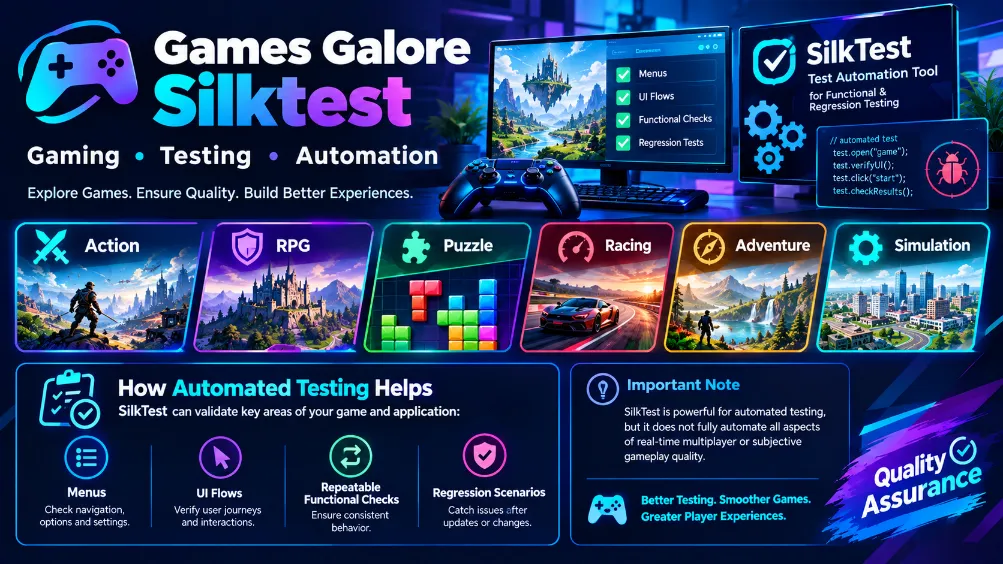
Games Galore and the SilkTest Gaming Connection
Games Galore content brings gaming subjects together under one category, covering different game styles, platforms, guides, and technology-related topics.
The SilkTest side adds a technical perspective. Game-related software can contain login systems, menus, settings, account pages, payment screens, inventory systems, and other interfaces that require regular testing.
This creates several related search terms:
| Search phrase | Main subject |
|---|---|
| Games Galore Silktest | Gaming and software testing |
| SilkTest Games Galore | Games, QA, and automation |
| Silktest.org Games Galore | Gaming-focused content |
| SilkTest game testing | Automated game-related testing |
| Silktest games | Games and testing technology |
Game Genres Found Around Games Galore
Games Galore covers several popular gaming categories. Each genre creates different testing requirements because its controls, interfaces, and systems can vary.
- Action games: Focus on controls, combat, movement, menus, and response time.
- RPG games: Test character menus, inventories, quests, progression, and equipment systems.
- Puzzle games: Check levels, scoring, controls, menus, and game logic.
- Racing games: Test vehicle controls, tracks, timing systems, menus, and settings.
- Adventure games: Check missions, interaction systems, locations, dialogue, and progression.
- Simulation games: Test management systems, resource controls, menus, and repeated actions.
The range of genres gives Games Galore Silktest a broad gaming focus rather than restricting the subject to one type of game.
How SilkTest Fits Game Testing
SilkTest works particularly well with repeatable software tasks. In a gaming environment, testers can apply automation to structured functions such as login pages, menus, account systems, settings, and store interfaces.
A testing system can repeat the same actions across different software versions. This approach helps teams spot interface problems after updates without manually repeating every basic step.
Human testing still has a place in game development. Gameplay feel, balance, graphics, sound, movement, and unusual player behavior require a different testing approach.
Benefits of Automated Game Testing
Automated testing can reduce repetitive manual work during software development and release cycles.
Useful benefits include:
- Faster regression checks
- Repeatable test execution
- Consistent interface testing
- Earlier detection of software defects
- Broader coverage of repetitive workflows
- Automated reporting
- Support for multiple platforms
- Less repetitive manual work
Automation becomes especially useful for tasks that testers need to repeat after every patch or software update.
Where Human Testing Still Helps
Automation cannot judge every part of a game experience. A script can verify that a menu button works, but it cannot fully judge how enjoyable a combat system feels or how balanced a multiplayer match appears.
Human testers can assess:
- Gameplay balance
- Visual quality
- Sound
- Character movement
- Control response
- Level design
- Player comfort
- Unexpected interactions
- Multiplayer behavior
- General usability
A strong QA process can combine automated checks with manual gameplay sessions.
Games Galore Silktest for Different Platforms
Modern games can reach users through desktops, browsers, smartphones, tablets, and other platforms. Each platform may create different requirements for controls, screen sizes, input methods, and compatibility.
SilkTest-based testing can help verify structured interface functions across supported software environments.
A cross-platform testing plan may cover:
- Account login
- Main-menu navigation
- Game settings
- Save and load functions
- Store interfaces
- Mouse or touch controls
- Screen-size behavior
- Error messages
- Session recovery
- Regression testing
Common Challenges With Games Galore Silktest
Game software can create testing challenges that ordinary business applications may not present. Real-time interaction, multiplayer sessions, graphics, physics, networking, and unpredictable player actions can make complete automation difficult.
Common challenges include:
- Random game events
- Real-time multiplayer actions
- Frequent interface changes
- Regular software updates
- Graphics-heavy scenes
- Frame-rate requirements
- Hardware differences
- Network problems
- Controller input
- Anti-cheat systems
A practical approach focuses automation on stable and repeatable workflows instead of trying to automate every part of gameplay.
A Practical Games Galore Silktest Workflow
A clear workflow can help QA teams decide which game functions should receive automation.
Step 1: List repeatable actions
- Start with login screens, menus, settings, account functions, and other predictable workflows.
Step 2: Select stable test cases
- Choose scenarios that should produce the same results across repeated runs.
Step 3: Create automation scripts
- Develop scripts for the software interfaces and workflows selected for automation.
Step 4: Run regression checks
- Run the same test collection after patches, updates, interface changes, or new releases.
Step 5: Review failures
- Examine test results and failed steps to identify software problems.
Step 6: Add manual sessions
- Use human testers for gameplay, balance, graphics, sound, controls, and unusual player actions.
Games Galore Silktest and QA Efficiency
Repetitive testing can take considerable time, especially during frequent game updates. Automation allows testers to run the same basic checks without repeating every action by hand.
This gives QA teams more time for new content and less predictable scenarios.
Automation can work well for:
- Regression suites
- Smoke tests
- Interface verification
- Account workflows
- Store interfaces
- Settings checks
- Release validation
- Cross-platform interface checks
What Players Can Find in Games Galore Content
Games Galore content can cover many areas of digital gaming. Readers may find subjects related to game genres, gaming platforms, guides, software, technology, and online entertainment.
Topics can cover:
- New gaming platforms
- Game guides
- RPG games
- Action titles
- Puzzle games
- Online gaming
- Gaming technology
- Platform information
- Game-related software
- Digital entertainment
This broad range makes the phrase Games Galore Silktest relevant to searches combining gaming subjects with software testing.
Games Galore Silktest vs. Traditional Manual Testing
| Area | Automated approach | Manual approach |
|---|---|---|
| Repetitive checks | Strong fit | Requires more time |
| Menu testing | Strong fit | Useful for exploratory work |
| Regression testing | Strong fit | Requires repeated effort |
| Gameplay feel | Limited | Strong fit |
| Visual judgment | Limited | Strong fit |
| Random events | Limited | Strong fit |
| Fixed workflows | Strong fit | Useful during validation |
| Multiplayer behavior | Partial | More flexible |
Automation and manual testing serve different purposes. Automated checks handle repeatable verification, while manual sessions give testers freedom to react to unexpected behavior.
Why Games Galore Silktest Matters for Gaming QA
Games combine many software systems, including interfaces, online services, account functions, purchases, graphics, networking, controls, and interactive mechanics.
A problem in one area can affect the player experience. Automated testing can help QA teams check structured software functions repeatedly, while manual testing can cover gameplay elements that require human judgment.
Games Galore adds the gaming side by covering game categories, platforms, gaming technology, and digital entertainment.
Games Galore Silktest for Modern Game Development
Modern game development requires testing across several layers. A single title may contain menus, accounts, online services, purchases, settings, achievements, save systems, and multiplayer features.
A useful testing plan can divide these areas into automated and manual categories.
Good candidates for automation:
- Login workflows
- Menu navigation
- Account settings
- Store interfaces
- Repeated UI actions
- Regression tests
- Basic error handling
Better suited to manual testing:
- Gameplay balance
- Visual presentation
- Sound
- Game controls
- Player experience
- Multiplayer interaction
- New gameplay mechanics
This division allows each testing method to handle the type of work it suits best.
Final Takeaway on Games Galore Silktest
Games Galore Silktest connects gaming content with software quality assurance. The gaming side covers genres, platforms, technology, and digital entertainment, while the SilkTest side relates to automated testing and repeatable software validation.
For QA teams, automation can handle predictable workflows such as menus, account systems, settings, and regression checks. Manual testing can then focus on gameplay, controls, graphics, sound, balance, and unusual situations.
Together, these approaches provide a practical framework for checking the software systems behind modern gaming experiences.