
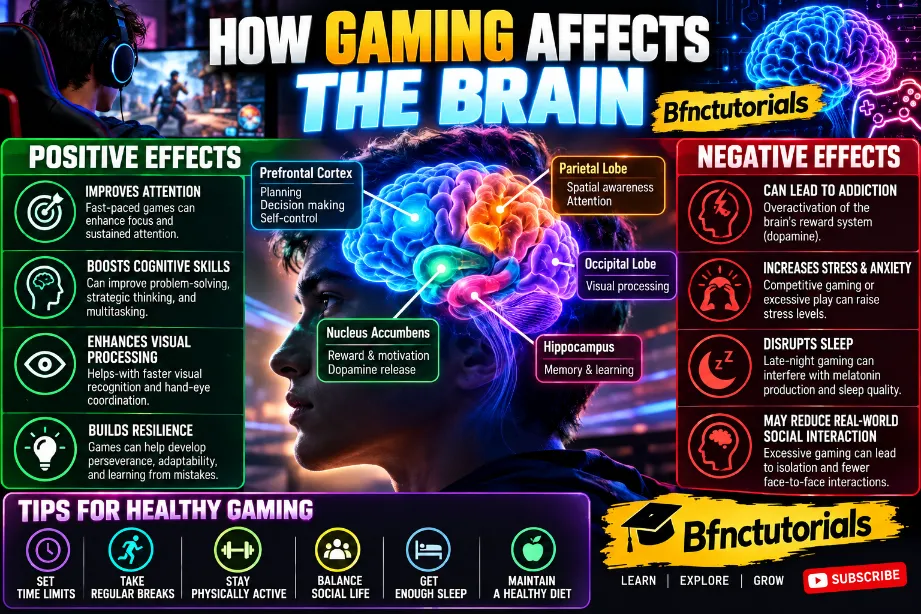
How Gaming Affects the Brain Bfnctutorials explains how video games can affect memory, attention, decision-making, emotions, coordination, and learning. Different types of games place different demands on the brain, so the effects can vary based on the game, gaming habits, session length, and daily routine.
Brain Functions Affected by Gaming
| Brain Function | Possible Gaming Effect |
|---|---|
| Attention | Faster responses to visual signals |
| Memory | Practice with recall and information storage |
| Decision-Making | Faster choices during game situations |
| Problem-Solving | Practice with logical tasks |
| Coordination | Better connection between vision and movement |
Main Points
- Action games require rapid visual processing.
- Puzzle games use logical reasoning.
- Strategy games require planning and resource management.
- Sports and racing games require timing and coordination.
Gaming and Memory
Many games require players to remember maps, missions, controls, character abilities, locations, and game rules. Repeated practice can give the brain regular memory exercises.
| Memory Type | Gaming Example |
|---|---|
| Short-Term Memory | Remembering current objectives |
| Working Memory | Managing several tasks |
| Visual Memory | Recalling maps and locations |
| Long-Term Memory | Retaining game rules and skills |
Possible Benefits
- Better recall during game tasks.
- Faster recognition of familiar patterns.
- Regular practice with information retention.
Gaming and Attention
Video games can require constant attention to objects, sounds, movement, and changing situations. Fast-paced titles may demand rapid visual processing and quick reactions.
| Attention Skill | Gaming Activity |
|---|---|
| Visual Attention | Tracking objects on screen |
| Selective Attention | Focusing on a target |
| Sustained Attention | Staying focused during longer tasks |
| Reaction Speed | Responding to sudden changes |
Examples
- Racing games require attention to roads and obstacles.
- Action games require target tracking.
- Sports games require attention to players and movement.
- Strategy games require monitoring several elements at once.
Gaming and Problem-Solving
Games can present puzzles, missions, resource limits, and strategic challenges. Players may need to test different approaches and adjust their plans after an unsuccessful attempt.
| Game Type | Skill Practiced |
|---|---|
| Puzzle Games | Logical reasoning |
| Strategy Games | Planning |
| Simulation Games | Resource management |
| Adventure Games | Decision-making |
Common Mental Tasks
- Finding solutions.
- Selecting between different options.
- Managing limited resources.
- Adjusting plans after failure.
Gaming and Decision-Making
Many games require rapid choices. A player may need to select a route, choose equipment, manage resources, or react to another player’s action within a short period.
| Situation | Mental Activity |
|---|---|
| Choosing a route | Planning |
| Selecting equipment | Evaluation |
| Managing resources | Calculation |
| Responding to opponents | Fast decision-making |
Regular gaming can provide repeated practice with these types of choices, although the skills gained can vary by game and individual.
Gaming and Hand-Eye Coordination
Gaming connects visual information with physical movement. Players use controllers, keyboards, mice, or touchscreens while watching objects move across the display.
| Gaming Activity | Related Skill |
|---|---|
| Target Tracking | Visual precision |
| Racing Games | Timing |
| Sports Games | Movement control |
| Action Games | Fast reactions |
Possible Effects
- Faster hand responses.
- Better timing.
- More precise movements.
- Stronger visual-motor coordination.
Gaming and Emotional Responses
Games can create excitement, frustration, satisfaction, tension, and motivation. Winning a difficult match may produce a sense of achievement, while repeated failure can create frustration.
| Emotion | Common Gaming Trigger |
|---|---|
| Excitement | Winning |
| Satisfaction | Completing a difficult task |
| Frustration | Repeated failure |
| Motivation | Rewards and progress |
| Tension | Competitive situations |
The emotional response can differ from one person to another and can also depend on the game genre.
Social Gaming and the Brain
Multiplayer games require communication, teamwork, coordination, and shared decision-making. Players may communicate through voice chat, text, or in-game signals.
| Social Activity | Skill Practiced |
|---|---|
| Team Coordination | Cooperation |
| Voice Chat | Communication |
| Shared Missions | Group problem-solving |
| Competitive Matches | Strategic response |
Social Gaming Activities
- Coordinating with teammates.
- Sharing information.
- Assigning tasks.
- Responding to group decisions.
Gaming and Learning
Games can create interactive learning environments. Educational titles may use challenges, rewards, simulations, and repetition to present information.
| Learning Area | Example |
|---|---|
| Mathematics | Number challenges |
| Language | Vocabulary activities |
| Science | Interactive simulations |
| History | Historical settings |
| Geography | Maps and location tasks |
Learning Features
- Interactive practice.
- Immediate feedback.
- Repetition.
- Goal-based tasks.
- Problem-solving exercises.
Potential Problems With Excessive Gaming
Gaming itself does not produce the same result for every person. Long sessions can create practical issues, especially if gaming takes time away from sleep, exercise, school, work, or other daily activities.
| Possible Issue | Effect |
|---|---|
| Long Sessions | Physical inactivity |
| Late-Night Gaming | Less sleep |
| Extended Screen Use | Eye discomfort |
| Poor Time Control | Missed daily tasks |
| Limited Breaks | Physical discomfort |
Healthy Gaming Habits
- Take regular screen breaks.
- Maintain a consistent sleep schedule.
- Make time for physical activity.
- Keep gaming within a planned schedule.
- Balance gaming with school, work, family time, and hobbies.
Brain Areas Used During Gaming
Different gaming tasks can activate different brain systems.
| Brain Area | Main Role |
|---|---|
| Prefrontal Cortex | Planning and decision-making |
| Hippocampus | Memory |
| Visual Cortex | Processing visual information |
| Motor Cortex | Movement |
| Reward System | Motivation and pleasure |
Game design can determine which mental processes receive more use. A puzzle game can place greater demands on reasoning, while a fast action game can place greater demands on visual attention and reaction speed.
Gaming, Sleep, and Daily Routine
Gaming late at night can reduce available sleep time. Bright screens, emotional stimulation, and extended sessions may also make it harder for some players to follow a regular bedtime routine.
| Habit | Possible Result |
|---|---|
| Gaming close to bedtime | Later sleep |
| Long evening sessions | Reduced rest |
| Regular breaks | Better screen management |
| Planned gaming hours | More balanced routine |
A consistent schedule can help keep gaming from interfering with rest and other daily activities.
Positive and Negative Effects of Gaming
| Potential Benefits | Potential Concerns |
|---|---|
| Faster reactions | Reduced physical activity |
| Visual-motor practice | Eye discomfort |
| Problem-solving practice | Excessive screen time |
| Memory practice | Sleep disruption |
| Team communication | Poor time management |
The overall effect depends on factors such as game type, playing habits, session length, age, and lifestyle.
Gaming and Brain Development
Children, teenagers, and adults can experience different gaming effects because brain development and daily responsibilities vary across age groups. Game content also matters. A strategy title can require different mental skills from a simple arcade game.
Areas That May Receive Practice
- Memory.
- Attention.
- Planning.
- Coordination.
- Spatial reasoning.
- Decision-making.
Balanced gaming can fit alongside physical activity, sleep, education, work, and social life.
Final Thoughts
How Gaming Affects the Brain Bfnctutorials covers several connections between gaming and brain activity, from memory and attention to coordination, decision-making, learning, and emotional responses. Different games create different mental demands. Healthy limits, regular rest, physical activity, and a balanced daily routine can help keep gaming as one part of a broader lifestyle.