
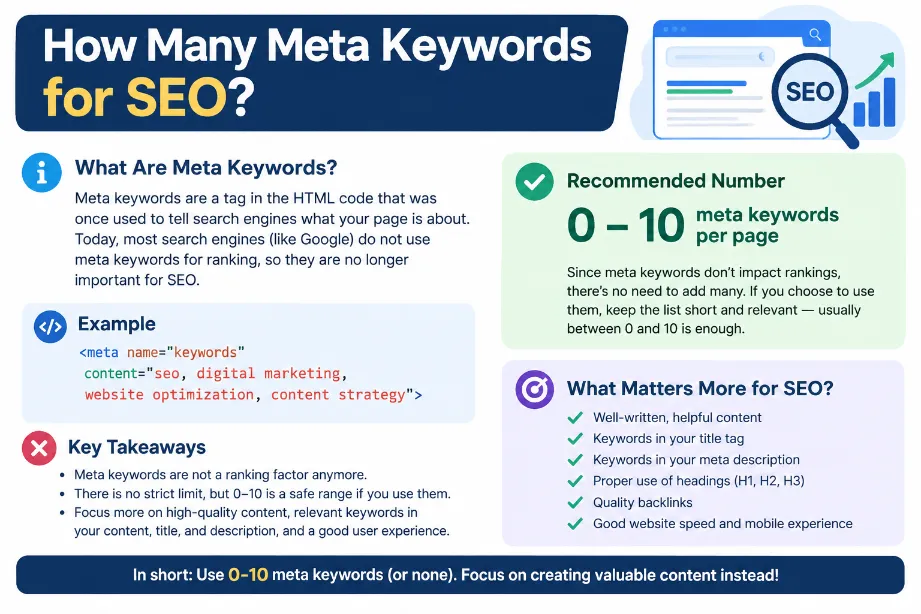
For modern SEO, the answer is zero.
Google Search does not use the meta keywords tag for ranking or indexing. Bing has also stated that the meta keywords tag provides no SEO value.
So, you do not need to add a list of search terms inside a meta keywords field. Your SEO work has more value across page titles, headings, useful content, internal links, image alt text, URLs, meta descriptions, and technical SEO.
How Many Meta Keywords Should You Add?
Use 0 meta keywords for SEO.
There is no recommended number such as 5, 10, 20, or 50. Adding more terms does not create a ranking advantage.
| Meta keyword count | SEO value | Recommended action |
|---|---|---|
| 0 | No ranking loss | Best approach |
| 1–5 | No ranking benefit | Skip the tag |
| 6–20 | No ranking benefit | Skip the tag |
| 21+ | No ranking benefit | Avoid large keyword lists |
The old SEO method relied on placing target terms inside a hidden HTML field. Search engines now rely on a much wider range of page and site signals.
Why Meta Keywords Lost Their SEO Value
The meta keywords tag became associated with keyword stuffing. Website owners could add long lists of search terms without adding useful information for visitors.
Search engines responded by reducing the value of this field. Google now ignores the meta keywords tag for Search ranking and indexing.
The practical answer for website owners is simple: there is no need to maintain a meta keywords list for Google SEO.
Meta Keywords vs. Real SEO Keywords
The phrase “meta keywords” can cause confusion because search terms still matter in SEO.
The difference lies in where those terms appear and how they support the page.
A target phrase can fit naturally into:
- Page title
- Main heading
- Subheadings
- Body copy
- Image alt text
- Internal anchor text
- URL, where appropriate
- Meta description
- Product names
- Category names
Search engines can use these areas to gain information about the subject of a page.
The goal should be useful wording rather than repeating the same phrase again and again.
How Many SEO Keywords Should One Page Target?
There is no fixed keyword count for a page.
One page can rank for a main phrase along with many related searches. The number depends on the subject, search intent, page format, and depth of information.
For a page about “how many meta keywords for SEO,” a practical keyword set could look like this:
| Keyword role | Example |
|---|---|
| Primary phrase | how many meta keywords for SEO |
| Close variation | meta keywords for SEO |
| Related phrase | meta keywords tag SEO |
| Question phrase | how many meta keywords should I use |
| Supporting phrase | are meta keywords still used |
Use these phrases naturally across useful sections. Avoid forcing every variation into a paragraph.
Should You Remove Meta Keywords From Old Pages?
For most websites, removing the tag can make page code cleaner. Leaving an old meta keywords field in place does not provide a Google ranking advantage.
A practical cleanup process looks like this:
- Check your CMS to see whether it creates the tag automatically.
- Remove the field from new page templates.
- Remove large keyword lists from old templates during regular maintenance.
- Keep page titles and meta descriptions relevant.
- Keep headings clear and descriptive.
- Review internal links across important pages.
- Check important URLs in your search performance tools after major template changes.
There is no SEO reason to spend time creating long meta keyword lists.
What Can Replace Meta Keywords?
Put your SEO effort into areas that provide useful information to search engines and visitors.
A strong setup can use:
- A clear page title
- One descriptive main heading
- Helpful subheadings
- Natural search terms
- Original information
- Relevant internal links
- Descriptive image alt text
- A useful meta description
- Crawlable URLs
- Appropriate structured data
- Solid technical SEO
Good SEO starts with a page that answers a real search need clearly.
How Many Keywords Should Go in a Meta Description?
A meta description does not work like a meta keywords field.
Write a concise description around the page topic and search intent. You can use the main phrase naturally, along with a related term where it fits.
A good meta description should:
- Describe the page accurately.
- Match the search intent.
- Use the main phrase naturally.
- Give users a clear reason to visit.
- Avoid repeated search terms.
- Read like normal human-written copy.
A string of keywords does not make a strong meta description. Clear language gives users a better idea of what they will find on the page.
Can Meta Keywords Hurt SEO?
The meta keywords tag itself does not provide Google ranking value.
The bigger issue comes from using outdated SEO tactics or filling a page with unnatural keyword lists.
Keyword stuffing can make content harder to read and may conflict with search engine spam guidelines.
Avoid adding hundreds of terms to hidden fields. Put useful phrases into relevant page content instead.
Does Bing Use Meta Keywords for SEO?
Bing has stated that meta keywords have no SEO value.
For Bing SEO, website owners can focus on areas such as:
- Crawl access
- Indexing
- Page titles
- Meta descriptions
- Useful content
- Internal links
- Site structure
- Technical SEO
- Search performance data
A website targeting Google and Bing therefore has little reason to maintain a meta keywords field for organic search.
What About Other Search Engines?
Different search platforms can use different signals, and their guidelines can change.
For general SEO, it makes more sense to focus on information that search engines can clearly read and visitors can actually use.
Focus on:
- Useful page content
- Clear titles
- Descriptive headings
- Crawlable internal links
- Accurate indexing settings
- Logical site structure
- Relevant references
- Helpful information
This also keeps your website cleaner and reduces time spent on an outdated SEO field.
A Simple SEO Keyword Setup for One Page
A practical workflow can stay simple:
- Pick one main search topic.
- Find closely related phrases and questions.
- Write a clear page title.
- Use the main topic in the main heading.
- Cover related questions through useful sections.
- Add internal links to relevant pages.
- Write a natural meta description.
- Add descriptive alt text to meaningful images.
- Remove forced keyword repetition.
- Monitor search impressions, clicks, and queries.
Search performance tools can show the search terms that bring visitors to your pages. This data can help you refine existing content and find additional topics worth covering.
Meta Keywords SEO Checklist
| SEO task | Recommended action |
|---|---|
| Meta keywords tag | Use 0 |
| Page title | Write a clear, relevant title |
| Main heading | Match the page topic |
| Body copy | Answer search intent naturally |
| Related terms | Add them only where useful |
| Meta description | Write a concise page summary |
| Internal links | Use descriptive anchor text |
| Images | Add descriptive alt text |
| Technical SEO | Keep pages crawlable and indexable |
| Search data | Review performance regularly |
Final Answer: How Many Meta Keywords for SEO?
Zero.
Meta keywords do not provide a Google ranking benefit, so there is no reason to add 5, 10, 20, or 50 terms to this field.
For modern SEO, put your keyword research into the page itself. Use relevant phrases across the title, headings, useful content, internal links, image descriptions, URLs where appropriate, and meta description.
Keep the wording natural, answer the search intent, and avoid keyword stuffing. That gives your SEO work a much more useful role than maintaining an outdated meta keywords field.