
How to Diagnose Pavatalgia Disease requires an important medical clarification. The term “pavatalgia” does not appear as an established diagnosis in mainstream medical terminology or peer-reviewed diagnostic literature. There are no accepted diagnostic criteria, dedicated laboratory tests, or standard imaging tests that confirm a disease called pavatalgia.
The word appears across various online health pages with different descriptions. Some pages connect it with foot or heel pain, while others mention nerve sensations, joint discomfort, or pain around the knee. Such variation makes self-diagnosis unreliable.
For a person experiencing pain or unusual sensations, the practical goal should be finding the actual medical cause.
Is Pavatalgia Disease a Recognized Diagnosis?
Current medical literature does not provide a consistent definition for pavatalgia disease. The ending “-algia” refers to pain in medical terminology, yet that suffix alone does not create a formal disease name.
| Medical point | Current information |
|---|---|
| Pavatalgia | No established diagnostic definition |
| Dedicated test | No validated test |
| Blood test | No specific pavatalgia test |
| MRI | Used only for suitable suspected conditions |
| X-ray | May help assess bones and joints |
| Physical examination | Useful for locating the source of symptoms |
| Main goal | Identify the actual cause of pain or discomfort |
A similar medical term, patellalgia, has appeared in medical literature in relation to pain around the patellofemoral area of the knee. This spelling difference matters because an unfamiliar term may result from a typing or transcription error.
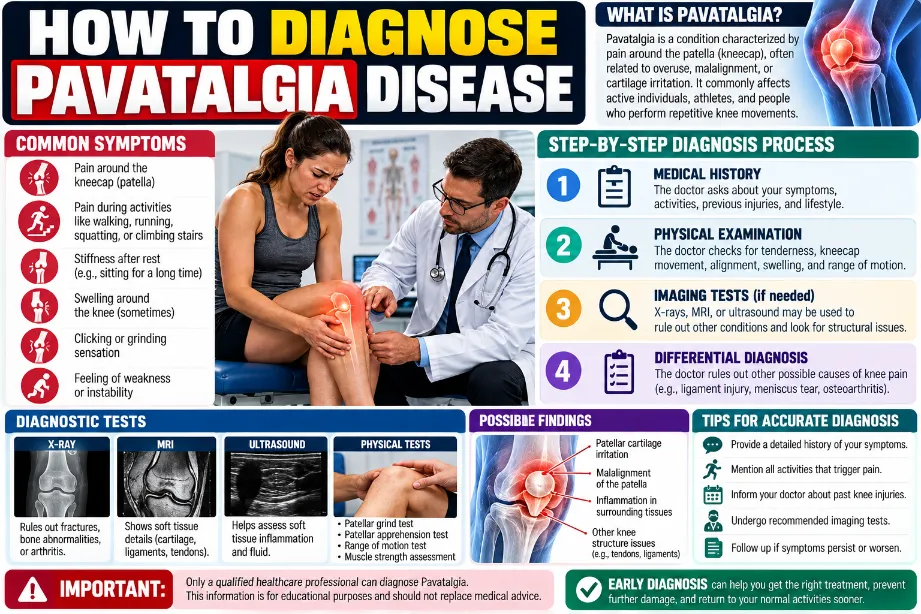
Start With the Main Symptoms
A doctor usually starts by asking about the symptoms rather than assigning the label pavatalgia disease.
Useful details can cover:
- Exact body area affected
- Type of pain
- Pain intensity
- Length of time symptoms have been present
- Activities that make symptoms worse
- Activities that provide relief
- Numbness or tingling
- Burning sensations
- Swelling or redness
- Muscle weakness
- Changes in walking or movement
- Previous injuries
A simple symptom diary can make these details easier to discuss during a medical appointment.
Medical History and Physical Examination
A healthcare professional can review previous injuries, surgeries, medications, physical activity, and other relevant medical details.
The physical examination may assess:
| Examination | Purpose |
|---|---|
| Pain location | Finds tender or painful areas |
| Joint movement | Checks mobility |
| Muscle strength | Looks for weakness |
| Sensation | Checks numbness or altered feeling |
| Reflexes | Helps assess nerve function |
| Walking pattern | Looks for movement changes |
| Swelling | Checks for visible inflammation or injury |
| Skin condition | Checks color, warmth, or other changes |
These findings help guide the next diagnostic step.
Check for Established Conditions
Since pavatalgia has no standardized medical definition, a doctor may consider established conditions that match the symptoms.
Possible causes depend heavily on the affected body area.
| Symptom pattern | Conditions a clinician may consider |
|---|---|
| Heel or sole pain | Plantar fasciitis, tendon problems, stress injury |
| Knee-area pain | Patellofemoral pain, patellar tendon problems |
| Burning or tingling | Nerve irritation or neuropathy |
| Pain traveling down a leg | Sciatica or another nerve-related condition |
| Foot numbness | Nerve compression or peripheral nerve problems |
| Joint pain | Arthritis, injury, inflammation, or structural problems |
This list does not provide a personal diagnosis. A clinical examination determines the most suitable explanation.
Imaging Tests for Pain Assessment
Imaging can help identify structural problems, though no scan specifically confirms pavatalgia disease.
| Test | Possible purpose |
|---|---|
| X-ray | Bone injury, fracture, alignment, or arthritis |
| Ultrasound | Selected tendon and soft-tissue problems |
| MRI | Detailed assessment of soft tissues, joints, nerves, and bones |
| CT scan | Detailed assessment of certain bone and structural problems |
A doctor selects imaging according to the symptoms and examination findings.
Nerve Tests for Tingling and Numbness
Some online descriptions connected with pavatalgia mention tingling, burning, pins and needles, or numbness. These sensations can fall under the medical term paresthesia.
Paresthesia can occur with nerve compression, irritation, injury, or several medical conditions. A clinician may assess sensation, reflexes, muscle strength, and nerve distribution.
In selected cases, nerve conduction studies or electromyography (EMG) can help assess nerve and muscle function.
| Symptom | Possible area of assessment |
|---|---|
| Tingling | Sensory nerve function |
| Numbness | Sensation and nerve pathways |
| Burning pain | Possible nerve-related causes |
| Muscle weakness | Motor nerve and muscle function |
| Radiating pain | Nerve pathway assessment |
Blood Tests and Laboratory Testing
There is no blood test that confirms pavatalgia disease. Laboratory testing may still help investigate other causes of pain, weakness, or abnormal sensations.
Depending on the clinical picture, a doctor may consider tests related to:
- Blood glucose
- Vitamin levels
- Thyroid function
- Blood counts
- Electrolytes
- Inflammation
- Other suspected medical conditions
The testing plan should come from a healthcare professional rather than an online symptom checklist.
Why Online Pavatalgia Descriptions Can Cause Confusion
Online pages use the term pavatalgia in several different ways. Some describe foot pain, while others associate the word with nerve symptoms, knee discomfort, or generalized pain.
This creates a major diagnostic problem because one medical label cannot reliably represent several unrelated symptom patterns without a defined clinical basis.
A genuine medical diagnosis usually has a clear definition, documented clinical features, research evidence, and an accepted diagnostic approach. Pavatalgia currently lacks this type of standardized medical framework.
Red Flags That Need Prompt Medical Attention
Some pain-related symptoms require prompt medical evaluation.
Seek medical care promptly for:
- Sudden severe pain
- New muscle weakness
- Loss of sensation
- Difficulty walking
- Major swelling
- Fever with painful or swollen tissue
- Severe pain after an injury
- New loss of bladder or bowel control
- Numbness around the groin area
- Rapidly worsening neurological symptoms
These signs can point toward conditions that require timely assessment.
How Doctors Investigate the Problem
There is no official diagnostic pathway specifically for How to Diagnose Pavatalgia Disease. A practical medical assessment can follow these steps:
- Describe the main symptoms.
- Point out the exact location of pain or altered sensation.
- Provide the symptom duration and pattern.
- Discuss previous injuries and medical history.
- Complete a physical examination.
- Assess nerves, muscles, joints, or other relevant structures.
- Use imaging or laboratory tests only as clinically appropriate.
- Refer to a specialist for persistent, severe, or complicated symptoms.
- Treat the diagnosed underlying condition.
Keep a Symptom Record
A short written record can help a doctor see patterns more clearly.
| Detail | Example |
|---|---|
| Pain location | Heel, foot, knee, hip, back |
| Sensation | Aching, burning, stabbing, pressure |
| Severity | 0–10 scale |
| Duration | Days, weeks, or months |
| Activity | Walking, running, sitting, standing |
| Other symptoms | Tingling, numbness, weakness |
| Previous treatment | Rest, medication, therapy |
| Previous tests | X-ray, MRI, blood test, EMG |
A symptom record can also help you describe changes between appointments.
Could Pavatalgia Be a Spelling Error?
A spelling error remains one possible reason for the term appearing in searches or records. Patellalgia, for example, appears in medical literature in connection with pain related to the patellofemoral region.
This does not mean pavatalgia automatically refers to patellalgia. The correct term depends on the symptoms, body area, and medical evaluation.
For this reason, copying a diagnosis from an online page can create confusion. Showing the exact spelling to a doctor can help clarify the intended term.
What to Tell Your Doctor
A useful medical appointment can start with a clear description of the problem.
Try to provide:
- Where the pain starts
- Where it travels
- How the sensation feels
- How long it has lasted
- Activities that worsen it
- Activities that reduce it
- Any numbness or tingling
- Any weakness
- Any recent injury
- Any previous tests or treatments
This information gives the clinician a practical starting point for further assessment.
Final Takeaway
How to Diagnose Pavatalgia Disease starts with identifying the actual symptoms rather than assuming that pavatalgia represents a confirmed disease. Current medical literature does not establish pavatalgia as a standardized diagnosis with accepted diagnostic criteria or a dedicated test.
Pain, numbness, tingling, weakness, and mobility problems can have many different causes. A healthcare professional can examine the affected area, review medical history, and order suitable tests to identify the underlying condition.
A precise diagnosis provides a much safer basis for treatment than relying on an unfamiliar online medical label.