
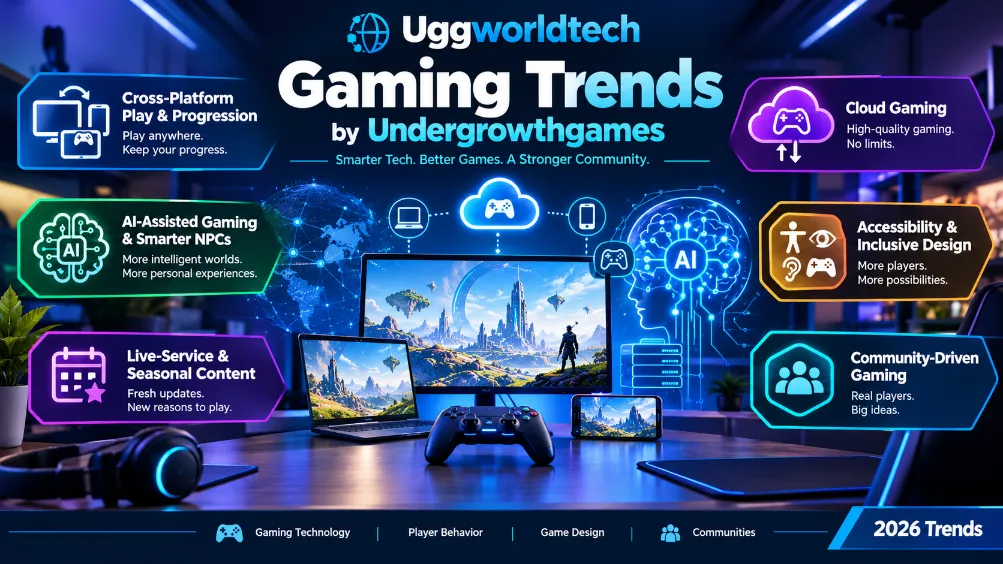
Uggworldtech Gaming Trends by Undergrowthgames covers the technologies and player habits shaping modern gaming. Current gaming developments point toward cross-platform play, cloud gaming, AI-assisted experiences, immersive hardware, live-service models, accessibility, and community-led development.
For gamers, these changes affect how games are accessed, updated, customized, and enjoyed with friends. For developers, they create new priorities around performance, social systems, content delivery, security, and player feedback.
Uggworldtech Gaming Trends at a Glance
| Gaming trend | What it means for gamers | Developer focus |
|---|---|---|
| Cross-platform gaming | Friends can use different devices | Account systems and matchmaking |
| Cloud gaming | Games can run through remote servers | Low latency and server capacity |
| AI in gaming | Smarter NPCs and personalized assistance | Useful AI behavior and controls |
| Live-service content | Games receive regular updates | Fresh content and game balance |
| VR and AR | More immersive digital experiences | Comfort and responsive controls |
| Accessibility | More gamers can use the same game | Flexible controls and readable interfaces |
| Community development | Players can share feedback | Testing systems and moderation |
Cross-Platform Gaming Changes the Player Experience
Cross-platform gaming has expanded multiplayer communities beyond one hardware group. PC, console, and cloud users can share multiplayer spaces across supported titles. Cross-progression can also allow purchases and progress to move between compatible devices.
This approach gives gamers several practical benefits:
- Larger matchmaking pools
- More ways to play with friends
- Greater device flexibility
- Shared multiplayer communities
- Less pressure to purchase identical hardware
For developers, cross-platform support requires reliable account linking, consistent game data, matchmaking controls, and strong security.
Cloud Gaming Reduces the Hardware Barrier
Cloud gaming changes the role of local hardware. Rather than relying completely on a powerful gaming PC or console, users can access supported games through remote computing systems.
The experience depends heavily on network quality. Fast multiplayer games need responsive controls, which makes latency a major concern.
Gamers should pay attention to:
- Internet stability
- Connection latency
- Supported resolutions
- Controller compatibility
- Data usage
- Server availability
- Regional support
As internet infrastructure improves, cloud gaming can provide another route to accessing demanding titles.
AI Adds New Options for Game Design
Artificial intelligence has several uses across gaming. Developers can apply AI to NPC behavior, personalization, procedural content, player assistance, testing, and gameplay analytics.
AI can support different areas of the gaming experience:
- NPCs can react to player actions in varied ways.
- Training systems can adjust challenges around player performance.
- Development teams can use automated tools during testing.
- Personalized systems can modify selected gameplay experiences.
- Teams can process large amounts of gameplay data more quickly.
Good AI design needs clear limits. Players need predictable controls, understandable systems, and options for adjusting automated assistance.
Live-Service Games Depend on Regular Content
Live-service games operate around updates rather than a single release. Seasonal content, patches, events, balance adjustments, new items, and fresh modes can keep a game active for long periods.
For gamers, this model can mean:
- Regular gameplay changes
- New maps or modes
- Balance patches
- Seasonal rewards
- Cosmetic items
- Frequent updates
For studios, this model creates a long-term production workload. Content planning, server support, moderation, testing, and communication all require regular attention.
VR and AR Push Gaming Toward More Immersion
Virtual reality and augmented reality add another layer to gaming. VR places users inside a digital environment, while AR adds digital elements to the physical surroundings.
Games using these technologies demonstrate different approaches to immersive play. Hardware improvements also matter. Lighter headsets, better tracking, improved displays, and more comfortable controls can make longer sessions easier.
Developers need to focus on:
- Motion comfort
- Controller response
- Interface readability
- Tracking accuracy
- Session length
- Physical play space
Accessibility Opens Gaming to More Gamers
Accessibility features affect who can comfortably use a game. Remappable controls, adjustable text, scalable interfaces, color settings, subtitles, audio controls, and other options can reduce barriers for users with different needs.
Useful accessibility options can cover:
- Controller remapping
- Subtitle customization
- Text-size controls
- Color and contrast settings
- Audio adjustments
- Difficulty assistance
- Alternative input methods
Accessibility works best as part of game design from an early stage rather than as a late addition.
Community Input Has More Weight in Game Development
Player feedback has become an active part of many development cycles. Early-access releases, beta tests, surveys, feedback channels, and community events give studios direct information about gameplay experiences.
A useful feedback system can help teams identify:
- Gameplay problems
- Balance concerns
- Interface issues
- Technical bugs
- Unpopular mechanics
- Features players want improved
Developers still need to review feedback carefully. A request from one section of a community may not represent the wider player base. Gameplay data and structured testing can provide additional evidence.
Player-Driven Economies Need Clear Rules
In-game economies have become an important design area across multiplayer and live-service games. Users may earn, trade, spend, or unlock digital items through different systems.
A healthy game economy needs clear rules around:
- Item supply
- Currency creation
- Currency removal
- Trading restrictions
- Pricing
- Fraud prevention
- Account security
Clear economy systems make it easier for gamers to know what digital currencies and items actually provide.
What These Trends Mean for Game Developers
The Uggworldtech Gaming Trends by Undergrowthgames topic points toward several practical areas for development teams.
- Performance: Reduce latency and improve loading times.
- Cross-play: Support reliable multiplayer across compatible devices.
- AI: Apply AI where it adds useful gameplay value.
- Community tools: Provide clear channels for player feedback.
- Accessibility: Offer flexible controls and interface settings.
- Live content: Plan updates around sustainable production schedules.
- Economies: Keep digital currencies and trading systems clear.
- Security: Protect accounts, purchases, and user data.
What Gamers Can Watch in 2026
For gamers following Uggworldtech Gaming Trends by Undergrowthgames, several areas deserve attention during 2026:
- Cloud access — More games are testing ways to reduce dependence on local hardware.
- AI assistance — Development teams are testing smarter NPCs and player-support tools.
- Cross-platform systems — Shared progression and multiplayer access remain important areas.
- Immersive hardware — VR and AR technology remain active development areas.
- Community participation — Player feedback can shape patches and future features.
- Accessibility settings — Flexible controls and interface options are becoming more common.
- Live updates — Seasonal content and regular patches remain popular release models.
Uggworldtech Gaming Trends for Developers and Gamers
Uggworldtech Gaming Trends by Undergrowthgames brings several areas of modern gaming into one discussion: cross-platform access, cloud infrastructure, AI, immersive technology, live-service design, accessibility, community participation, and digital economies.
For gamers, these changes affect access, multiplayer options, customization, and new content. For developers, they create practical tasks around performance, moderation, testing, accessibility, security, and long-term content planning.
The gaming industry changes rapidly, so individual titles may adopt these technologies at different speeds. Looking at actual game features, developer updates, player feedback, and technology changes gives gamers a clearer view of where the industry is heading.
What are Uggworldtech Gaming Trends by Undergrowthgames?
Uggworldtech Gaming Trends by Undergrowthgames refers to gaming-focused coverage centered on technology, player behavior, game development, and emerging industry directions.
Which gaming trends receive the most attention?
Major areas discussed under this topic are cross-platform gaming, cloud gaming, AI, live-service content, VR and AR, accessibility, community-led development, and player-focused economies.
Does Uggworldtech focus only on new games?
No. The wider subject covers gaming trends, tips, updates, technology, community topics, and different types of games.
How can developers use these gaming trends?
Developers can apply these trends to product planning, including cross-platform support, AI systems, accessibility features, community feedback, live content, performance improvements, and secure digital economies.
Why does cross-platform gaming matter to gamers?
It can allow friends using different supported devices to share multiplayer experiences. Cross-progression can also make it easier to move between compatible devices.