
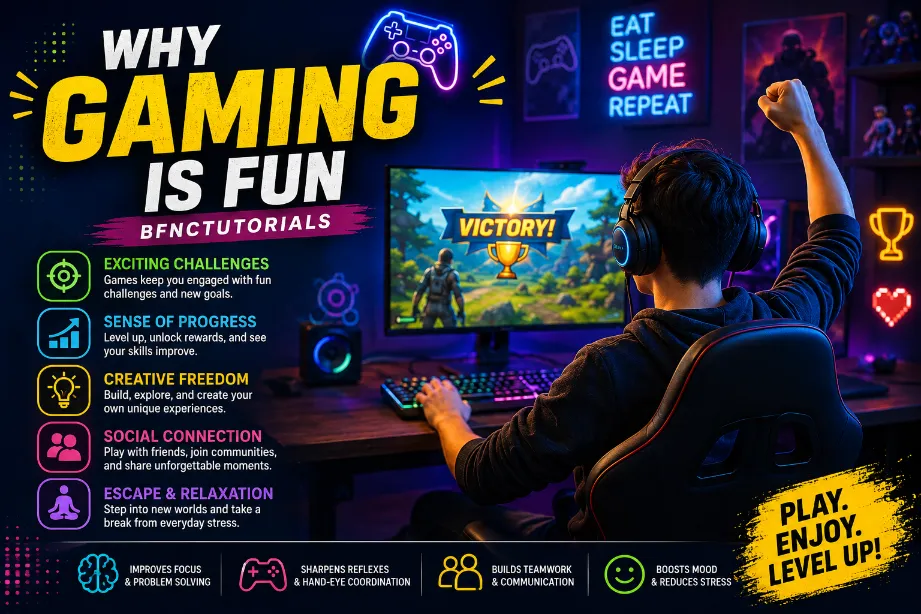
Gaming offers a mix of challenge, entertainment, creativity, and social interaction. A good game can turn a short break into an exciting experience or provide hours of focused entertainment. Why Gaming is Fun Bfnctutorials covers the main reasons games attract different types of players and keep each session engaging.
Why Gaming Feels So Enjoyable
Games give players clear goals, rewards, challenges, and choices. Each element adds a reason to keep going. Finishing a difficult level, finding a hidden item, or beating a tough opponent can create a strong sense of satisfaction.
Several elements make gaming enjoyable:
- Challenge: Difficult tasks give players something to work toward.
- Rewards: Points, items, ranks, and achievements provide motivation.
- Choice: Many games allow players to select characters, weapons, locations, or strategies.
- Creativity: Sandbox and simulation games give room for personal ideas.
- Social play: Multiplayer games create opportunities for teamwork and friendly competition.
- Progress: New skills and better results make each session feel productive.
Gaming Gives the Brain Something to Solve
Many games present problems that require quick decisions. Players may need to locate an object, defeat an opponent, manage resources, or select the right route.
This type of activity keeps attention focused. Puzzle games rely heavily on logic, while strategy games require planning and resource management. Action games can demand fast reactions and accurate timing.
| Gaming Element | What It Offers |
|---|---|
| Puzzles | Logic and problem-solving |
| Strategy | Planning and decision-making |
| Action | Speed and reaction practice |
| Simulation | Creativity and management |
| Adventure | Discovery and progression |
| Multiplayer | Teamwork and competition |
Progress Makes Games More Rewarding
A major reason gaming feels satisfying comes from visible progress. Players can see their character become stronger, unlock new equipment, reach a higher rank, or access new areas.
Small achievements can also provide motivation. A player may start with a basic character and gradually develop better skills through practice.
Common progress systems include:
- Level upgrades
- New abilities
- Achievement badges
- Rank systems
- Unlockable areas
- Improved equipment
- Character customization
These systems give players short-term goals along with larger targets.
Games Allow Creative Freedom
Some games provide very few limits on player creativity. Building games, sandbox titles, simulation experiences, and design-focused games allow users to create structures, worlds, characters, or entire communities.
Creative freedom can make every session feel different. Two players may use the same game but create completely different experiences based on their personal choices.
Multiplayer Gaming Adds Social Fun
Gaming does not always happen alone. Multiplayer experiences allow friends and online teammates to work together, compete, communicate, and share memorable moments.
Cooperative games can encourage players to divide tasks and develop strategies. Competitive titles can create excitement through rankings, matches, and tournaments.
Social gaming can offer:
- Team communication
- Friendly competition
- Shared goals
- Cooperative missions
- Online communities
- Memorable match experiences
Gaming Can Offer an Escape From Routine
Daily routines can feel repetitive. Games provide a different environment filled with missions, challenges, characters, and fictional worlds.
A player may spend an evening racing cars, managing a virtual city, solving mysteries, fighting opponents, or exploring a fantasy setting. This variety gives gaming its broad appeal.
Different Genres Offer Different Types of Fun
Not every player enjoys the same type of game. Genre variety gives users plenty of choices based on mood and personal taste.
| Genre | Main Attraction |
|---|---|
| Action | Fast movement and combat |
| RPG | Character growth and customization |
| Strategy | Planning and resource control |
| Sports | Competition and realistic gameplay |
| Racing | Speed and competition |
| Puzzle | Logic and problem-solving |
| Simulation | Management and creativity |
| Adventure | Missions and discovery |
A person looking for relaxation may prefer simulation or casual games, while someone seeking competition may choose racing, sports, or action titles.
Sound and Visual Design Add to the Experience
Music, sound effects, graphics, animation, and character design all contribute to the gaming experience. A dramatic soundtrack can make a difficult scene feel more exciting. Detailed environments can make fictional locations feel immersive.
Good audio feedback also helps players react to events. Footsteps, alerts, weapon sounds, background music, and environmental effects can provide useful signals during gameplay.
Gaming Rewards Skill and Practice
Many games give players better results after repeated practice. A difficult level may feel frustrating during the first few attempts, yet successful completion can feel highly rewarding.
Practice can improve:
- Hand-eye coordination
- Timing
- Memory
- Pattern recognition
- Decision-making
- Strategic planning
- Reaction speed
The satisfaction comes from seeing personal improvement rather than simply receiving a reward.
Why Gaming Remains Popular
Gaming offers something for many moods and interests. A player can enjoy a five-minute puzzle, spend an hour competing online, or dedicate an entire evening to a large adventure.
Its appeal comes from several features working together:
- Interactive experiences
- Clear goals
- Personal choices
- Rewards and progression
- Creative opportunities
- Social interaction
- Competitive challenges
- Large genre variety
Bfnctutorials and the Gaming Experience
The phrase Why Gaming is Fun Bfnctutorials connects the topic of gaming enjoyment with an informational search style. Readers looking for gaming guidance may want simple explanations of game mechanics, features, strategies, or general gaming concepts.
Useful gaming content can help readers learn faster, discover new genres, and make better choices about the type of experience they want.
Final Thoughts on Why Gaming is Fun
Gaming combines challenge, creativity, competition, progression, and entertainment in one interactive format. Players can solve problems, develop skills, create virtual worlds, compete with others, or simply enjoy a relaxing session.
That variety gives gaming a broad appeal and makes it easy for different players to find an experience that suits their preferences.